The Promise and the Price of EdTech and AI



By Melinda Medina
I still remember the sound the chalk made when it scraped across the board, sharp, dry, unforgiving. I remember standing in front of a room full of students with disabilities, holding a piece of chalk in one hand and a stack of crumpled papers in the other, hoping I hadn’t forgotten the one document I’d need to justify why a student needed more time, more support, more patience. There were no dashboards. No data trackers. No digital accommodations menus. Just me, a chalkboard that never quite erased clean, and students whose needs far exceeded the resources in front of us.
It was a constant internal calculus: How do I meet everyone’s needs with what I have?
I taught in an under-resourced classroom where every student had an IEP and every day required improvisation. Lessons were handwritten again and again so they might finally click for a student who had been told, explicitly or implicitly, that they were “too much.” Data was tracked in notebooks. IEPs lived in overstuffed folders that followed me home in tote bags. I planned at night, differentiated by instinct, and carried the emotional weight of students who believed school was not built for them.
Years later, classrooms look radically different. The chalkboard has been replaced with Smartboards. The paperwork with platforms. The tote bags with cloud storage. Technology has expanded what’s possible in teaching and learning, offering powerful tools for instruction and organization. Yet its benefits depend on how it’s used, supported, and integrated into already demanding teaching lives.When implemented well, EdTech can enhance instruction and streamline workflows. When implemented poorly, it risks becoming another demand in an already overloaded system.
In my EdSurge piece, I wrote about witnessing burnout up close, not just in myself, but in colleagues who loved their students deeply and still found themselves depleted. What became clear was this: burnout thrives when care is individualized but systems are not.
This is where EdTech enters the conversation.
Where EdTech and AI Can Actually Lighten the Load
When educators hear “AI,” the reaction is often mixed: curiosity, skepticism, and a very real fear that it’s just one more thing we’re expected to master. That hesitation makes sense. Teachers have seen too many tools promised as solutions that quietly become additional responsibilities.
But when AI is used intentionally, to support thinking rather than replace it, it can meaningfully reduce workload while improving student access and differentiation. At its best, AI-enhanced EdTech doesn’t ask teachers to do more. It helps them do less repetition, less manual sorting, and less guesswork, especially in classrooms serving students with disabilities.
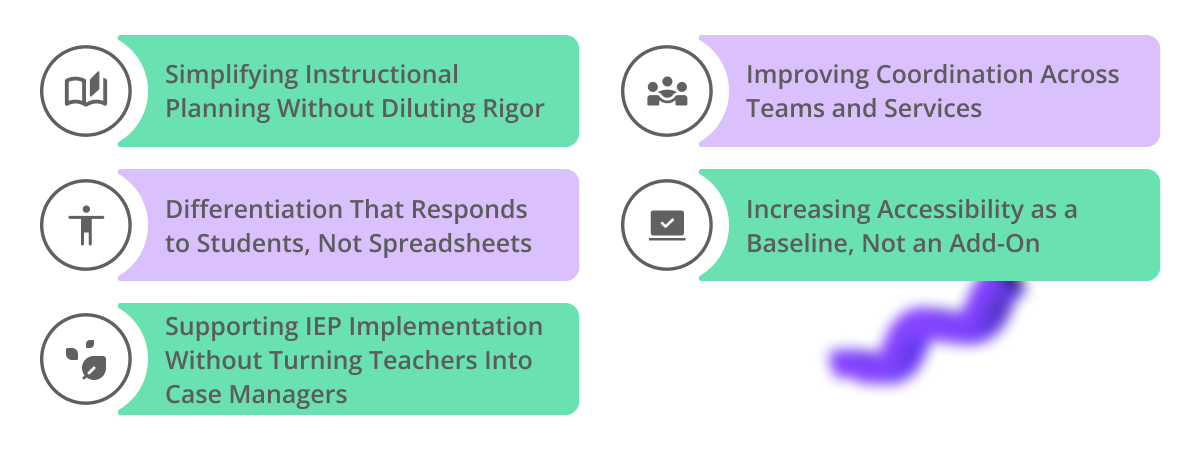
1. Simplifying Instructional Planning Without Diluting Rigor
Instructional planning is one of the most time-intensive aspects of teaching, particularly in inclusive and special education settings where lessons must be accessible across multiple skill levels. AI-supported platforms can help by:
- Generating reusable lesson templates aligned to standards that teachers can adapt rather than build from scratch
- Supporting multi-tiered differentiation, allowing educators to design one core lesson with embedded Tier 1, Tier 2, and Tier 3 supports
- Offering pacing tools that adjust based on student mastery rather than calendar pressure
- Providing adaptive content that responds to student performance in real time
2. Differentiation That Responds to Students, Not Spreadsheets
One of the greatest promises of AI lies in its ability to support responsive differentiation, particularly for students with disabilities, multilingual learners, and students with interrupted learning. AI-enabled tools can:
- Suggest scaffolds based on student performance patterns
- Adjust reading levels while preserving content complexity
- Offer multiple modalities for demonstrating understanding
- Reduce the lag between assessment and instructional response
3. Supporting IEP Implementation Without Turning Teachers Into Case Managers
IEP implementation is not just paperwork, it’s instructional responsibility layered with legal accountability. Too often, systems track compliance without supporting practice. AI-supported EdTech can help by:
- Centralizing IEP documentation so goals, accommodations, and services live in one accessible place
- Supporting ongoing progress monitoring with auto-generated summaries rather than raw data dumps
- Flagging trends related to goal mastery or stagnation so interventions can be adjusted earlier
- Helping educators align lesson plans directly to IEP goals without duplicating work
4. Improving Coordination Across Teams and Services
One of the quiet contributors to burnout is fragmentation and a lack of communication among stakeholders. Tech allows teachers, service providers, and administrators working in parallel systems that don’t often get time during the day to communicate.
Technology can reduce this friction by:
- Streamlining schedules for related services, co-teaching, and student movement
- Providing shared visibility into service delivery and instructional priorities
- Reducing redundant emails and last-minute disruptions
- Supporting clearer communication with families across languages and formats
5. Increasing Accessibility as a Baseline, Not an Add-On
Accessibility should not depend on individual teacher capacity or technical expertise. EdTech, especially when paired with AI, can help normalize access by embedding supports directly into instruction. These include:
- Text-to-speech and speech-to-text tools
- Real-time translation for multilingual learners and families
- Closed captioning and audio supports
- Multimodal learning options that honor different ways of processing information
The Pitfalls: When EdTech Becomes Another Layer of Labor

Too often, EdTech is introduced without reducing anything else. Instead of replacing outdated tasks, it stacks on top of them. Teachers are often asked to learn multiple platforms simultaneously, enter the same data in multiple systems, monitor dashboards that generate alerts without guidance, be available 24/7 through messaging tools and troubleshoot technology issues without training or tech support.
Research from Education Week and the OECD highlights a growing phenomenon: digital overload. When technology is implemented without coherence, it increases cognitive load and erodes planning time, contributing directly to burnout.
For special educators, this is compounded. IEP platforms may track compliance, but they rarely reduce the thinking required to individualize instruction. Data systems collect numbers but don’t interpret nuance. And no platform can replace the relational labor of supporting students who navigate trauma, disability, and systemic inequity.
Reframing the Conversation with EdTech That Actually Helps
I think back to that chalkboard classroom often. Not because I romanticize the struggle, but because it reminds me of what matters: clarity, connection, and care. Technology should serve those goals, not distract from them. It’s important to remember, burnout doesn’t happen because teachers aren’t innovative enough. It happens when innovation is used to stretch people further instead of supporting them better.
EdTech, and AI in particular, should not ask teachers to move faster. It should allow them to breathe, focus, and teach. That’s why implementation matters more than adoption. Tools must be selected with educators, aligned to instructional goals, and paired with protected time and clear boundaries.
I believe the question isn’t whether to use EdTech, it’s which tools reduce labor rather than redistribute it. Based on both research and lived experience, effective EdTech shares a few core characteristics like integration that allows tools to talk to each other. Platforms that integrate lesson planning, assessment, and accommodations reduce duplication and decision fatigue. Scheduling tools that auto-populate services, reminders for IEP deadlines, and progress monitoring systems that generate summaries (not just raw data) save time and mental energy. A human-centered design where educators should not need a tutorial marathon to use a tool because if it adds complexity, it’s not support. My personal big one is equity-aligned functionality and access. Tools must support multilingual families, accessibility needs, and varied learning profiles, without placing the burden on individual teachers to customize everything manually.
When technology simplifies planning, strengthens differentiation, supports IEP implementation, improves coordination, and expands accessibility, it becomes what it was always meant to be: a support system, not another weight.
This article was crafted by Melinda Medina, an independent contributor engaged by CheckIT Labs, Inc. to provide insights on this topic.

Melinda is an aspiring leader, consultant, special educator, published author, and advocate for equitable education. She holds a Master of Science in Teaching and a Master of Science in Educational Leadership, and has dedicated her career to supporting neurodiverse students and breaking generational cycles through education.