What Drives K-12 Teachers' Frustration with LMS Platforms



When we think about what makes teaching so demanding, the first things that come to mind are usually high emotional engagement, understanding the needs of each child, preparing lessons in advance, staying on top of grading, paperwork, extracurricular activities, progress reports, parent communication...
Yet somehow, one of the biggest challenges is not even on that list.
The issue we tend to overlook is the very one fueling the entire pile – the lack of a good learning management system. Even the most comprehensive edtech solutions cannot deliver results if educators are underprepared or underequipped to maximize their full potential. This fact alone causes frustrations that simply shouldn’t exist in the era of mature educational technology.
When Technology Becomes Just Another Task on Your To-Do List
When I first started working with a Learning Management System (LMS), I expected fireworks.
I anticipated a magnificent tool that would help lessen my workload and give me more time and resources to be present in the classroom by doing what I came there to do: teach, educate, motivate, and influence students. The promises were simple: technology is there to streamline administrative work, improve internal and external communication, and give you more time for teaching. We believe in this revolution in education. Unfortunately, our trust was broken.
Instead of curing our burnout and giving us a proper system that will make our organization function better, educators found themselves spending additional hours learning the platform on their own, troubleshooting technical issues and duplicating tasks across multiple systems making errors along the way.
What was initially meant to bring order only felt like another responsibility added to an already full workload. From something that should bring clarity and transparency, it turned out to be one more obligation.
My colleagues felt overwhelmed by yet another digital tool, learning the ropes, testing the functionalities, creating workarounds where the LMS did not fit the established workflows. Despite having more data than ever, the administrative work wasn’t getting any easier since there was a growing struggle to obtain meaningful insights with the existing information.
I believe the problem was not technology itself, but the traditional LMS platforms that were designed as content storage rather than the tools that truly support teaching and learning.
The Reality Behind LMS Frustration in Higher Education

Despite significant investments and improvements in technology, many institutions continue to experience challenges of using, implementing or understanding Learning Management Systems. This lack of involvement and comprehension paired with the pressure to perform leads to feelings of frustration stemming from several specific recurring issues.
1. Limited Training and Weak Onboarding Processes
Many LMS implementation processes depend too much on the educators’ ability to learn, adopt, and adapt to a completely new environment. Yet, a typical onboarding process consists of a single training session (1-2 hours) and impossible expectations regarding the level of proficiency to be gained by it. Some common challenges include:
- Insufficient onboarding support
- Expectations that teachers will learn the platform by themselves, independently
- Heavier workloads during transition periods
This practice alone is enough to create resistance toward new technologies because educators associate the platform with increased stress and workload rather than increased efficiency.
2. Inconsistent Lesson Planning and Course Structure
The lack of a standardized framework within a new LMS is what scares and demotivates most educators right away. If the look, feel, and structure of the new LMS is too different from what both teachers and students are used to, there is an increased defiance regarding novelty. Each teacher structures their lessons in a different manner; students struggle to navigate multiple courses, and schools often struggle to maintain quality across departments. On top of that, many LMSs lack integrated content planning tools, which is another realistic experience that can deter teachers from using the system.
An LMS is supposed to actively support instructional design rather than serve as a simple repository of materials. Everyone owns a Drive one way or the other and can store their materials however they wish. It is what we can do with those materials that can make a difference, and an LMS should offer help in that department.
3. Poor Integration with Student Information Systems and Other Tools
Supporting an education institution is never a streamlined, easy task. Many institutions rely on numerous digital systems simultaneously:
- Student Information Systems (SIS)
- Assessment platforms
- Content creation tools
- Comunication tools
- Reporting systems
And that’s just scratching the surface. When in this predicament, teachers often find themselves entering and filling out the same information multiple times across platforms because they don’t communicate with one another. Consequently, there are many issues like duplicating data, increased administrative burden, higher risk of errors, fragmented information...
4. Too Many Separate Tools for Everyday Tasks
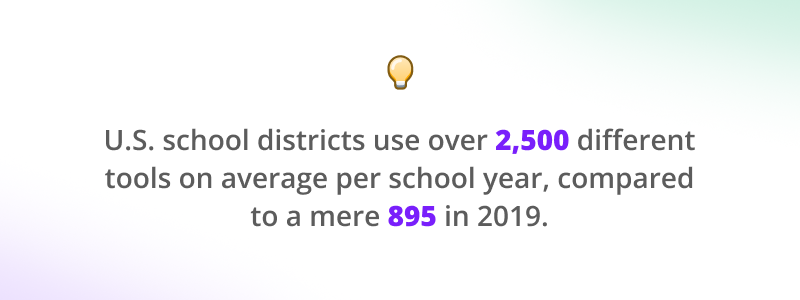
This ties directly to the previous point: there are too many tools and apps teachers must use every day which creates workflow friction. According to recent reports, U.S. school districts use over 2,500 different tools on average per school year, compared to a mere 895 in 2019.
Considering the figure, it’s unsurprising that information tends to get lost, misunderstood, and deleted. Constant switching reduces productivity and increases cognitive load, preventing teachers from focusing on teaching and making them look at screens or papers instead.
5. The Missing Layer of Neuroscience
After continuous use of Learning Management Systems, I have realized something: those platforms were so focused on delivering content, storing data and materials, tracking completion rates, that they offered little to no insight into how students actually learn. This realization occurred to me once I joined the team at CheckIT Learning, and discovered the potential of neuroscience-informed technologies. Some of the most important points I have learned early on were:
- Learning is not content consumption.
- Attention, memory retention, cognitive load, and engagement matter. A lot.
- Technology should help and guide educators to understanding learning behaviors.
- Data should support teaching rather than merely generating reports.
Modern educational platforms, like Cleo LMS, show us that this technology can move beyond administration and data collection. It should begin supporting evidence-based learning practices where students reach their full potential, and educators receive assistance and tools that don’t follow the one-fits-all approach but treasures individuality and personalization.
6. Fragmented communication
Communication towards parents or guardians, as well as between colleagues and students, becomes rather fragmented and difficult to manage. There are a few scenarios, like multiple Viber groups, consistent WhatsApp messages, Emails going to the spam folder, inconsistent information reaching some and not reaching others, privacy and data security concerns... This creates issues and challenges for everyone involved, starting from the school’s administration, and ending with students and their parents or guardians.
There is an insatiable need for a streamlined, centralized, transparent, and secure communication that keeps everyone informed without creating communication overload.
LMS Technology Should Remove Friction, Not Create It
Guided by the experience in the LMS sphere, my perspective has broadened and evolved as I learnt of new systems, tools and approaches to organizing educational institutions. Some of the key features that make digital platforms effective and efficient are:
- Reducing administrative burden
- Supporting instructional quality
- Improving collaboration and communication
- Providing meaningful learning insights
- Creating transparency for all stakeholders
The future of educational technologies is not adding or creating more tools to add on top of existing ones; it is creating connected ecosystems that will help educators focus on what matters most – supporting student success.

After earning a Master’s degree in Comparative Literature, Jana spent several years as a high school language teacher. Recognizing that her passion for educational transformation extends far beyond classroom walls, she joined CheckIT Learning to support the development of our neuroscience-informed LMS, Cleo.