7 LMS Features That Outcome-Driven K-12 Leaders Actually Need



And a rubric to make it easy to choose
By Dr. Joy VerPlanck
When school administrators and educators evaluate a Learning Management System (LMS), the conversation often gravitates toward efficiency: How well does it manage our rosters? Can it reduce the existing administrative burden? Does it integrate with our SIS?
These are reasonable questions. As a technologist, I personally appreciate a good tech stack where all the pieces play nicely with each other (so will your technology coordinator). But when the focus narrows too much to processes and efficiency, it becomes easy to lose sight of the outcomes that actually help students learn better.
Administrative efficiency and learning outcomes, while not opposites, don't automatically move in the same direction. A school can have a beautifully organized LMS and still watch students disengage, struggle to self-regulate, or coast through content that was never meaningfully personalized for them. Choosing an LMS on efficiency criteria alone is a bit like evaluating a hospital on how well it files paperwork.
Operational convenience should be assessed too, but should be assigned appropriate weight in the evaluation as bonus features. What outcome-driven educational leaders need is a platform built around how students actually learn, grounded in evidence-based cognitive science and developmental research. The seven features below are a starting point for the kind of evaluation that will get you both. Each feature includes a suggested rubric for your evaluation committee:
1. Student Progress Tracking Beyond Grades
Grades are a proxy. They summarize performance on discrete tasks, but they don't capture the skills that tend to predict long-term academic and life success, including executive function, self-regulation, goal-setting, task initiation, and cognitive flexibility.
An LMS designed for genuine outcomes should give educators visibility into these dimensions. That might mean tracking how a student approaches revision, whether they're improving at managing multi-step tasks over time, or how their organizational habits are developing across the school year. When a platform surfaces developmental progress alongside academic performance, teachers and counselors can intervene earlier, coach more precisely, and build a fuller picture of each student's growth over time.
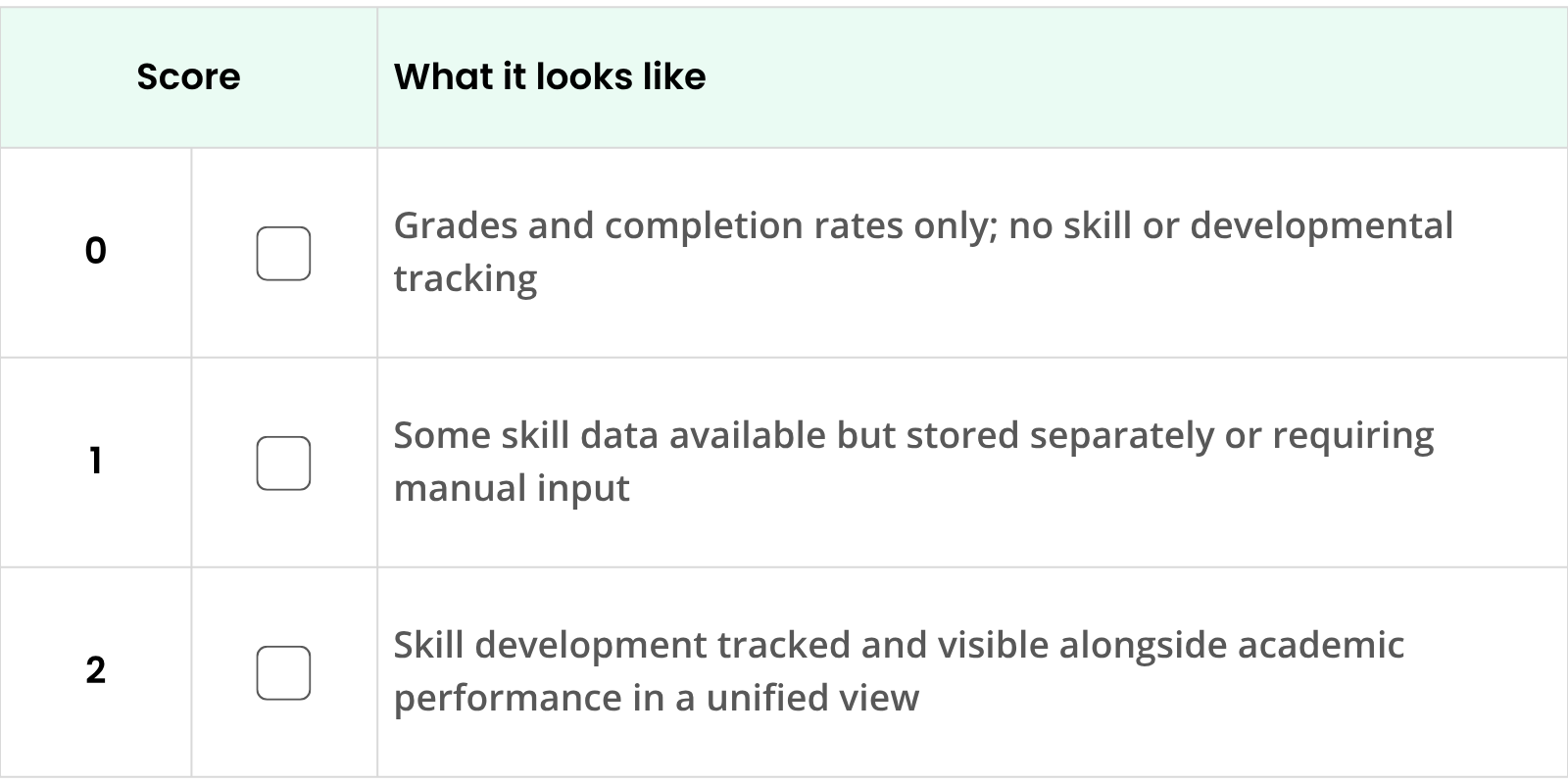
Rubric item:
Does this LMS make student skill development visible alongside academic performance, or only surface it separately?
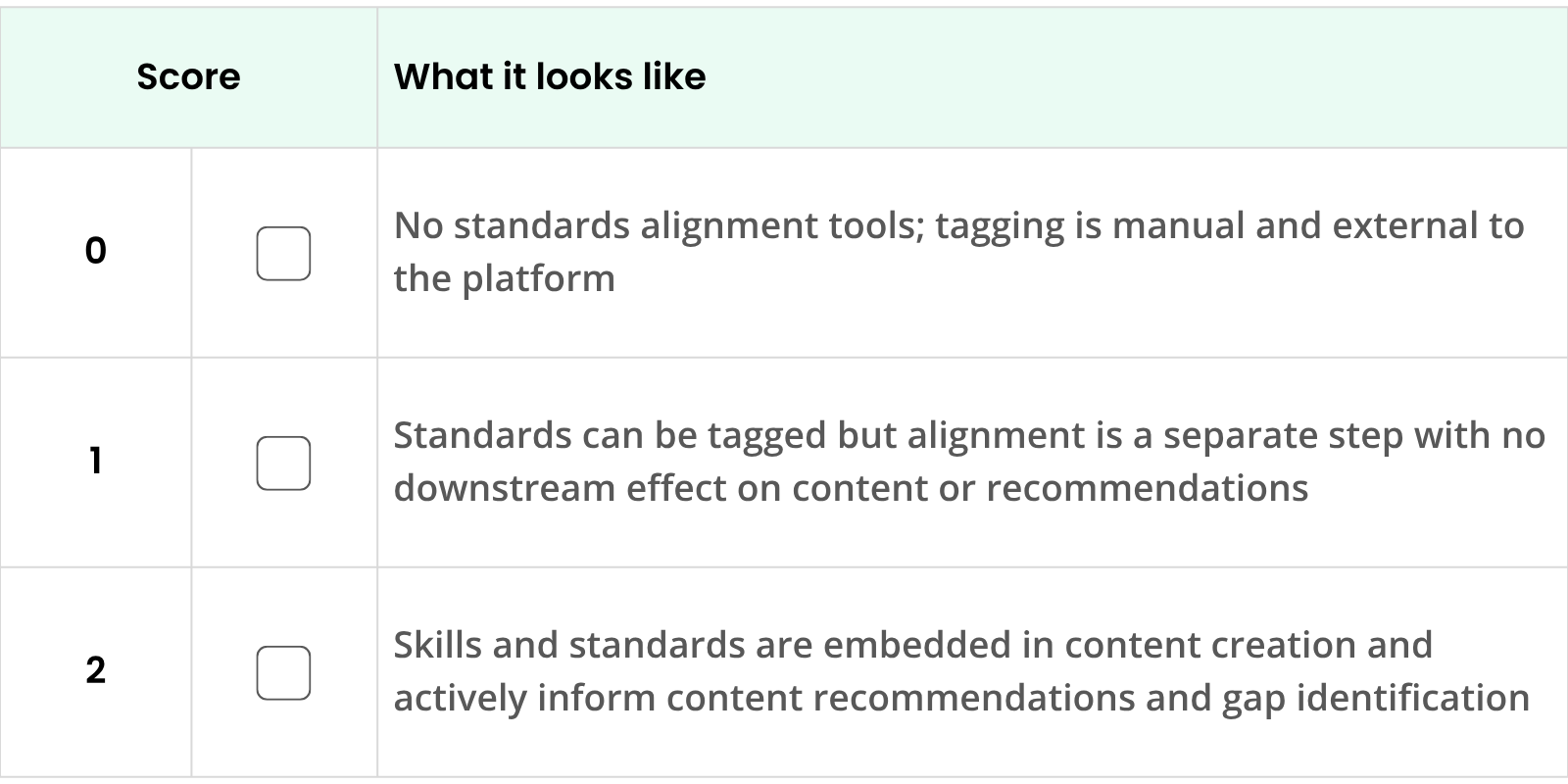
2. Skills and Standards Alignment in LMS Content Creation
Most educators know what standards they're teaching to. Fewer have a system that makes aligning content to those standards feel like a natural part of the workflow rather than a compliance checkbox.
A well-designed LMS should allow teachers to tag content to specific skills and standards during the creation process, and then use that structure to do something useful: adapting content recommendations, identifying gaps in coverage, or flagging when a student's performance on a skill suggests they need a different approach.
Rubric item:
Does this LMS integrate skills and standards alignment into the content creation process, or is it a separate step?
3. Personalized and Adaptive Learning Features in a K-12 LMS
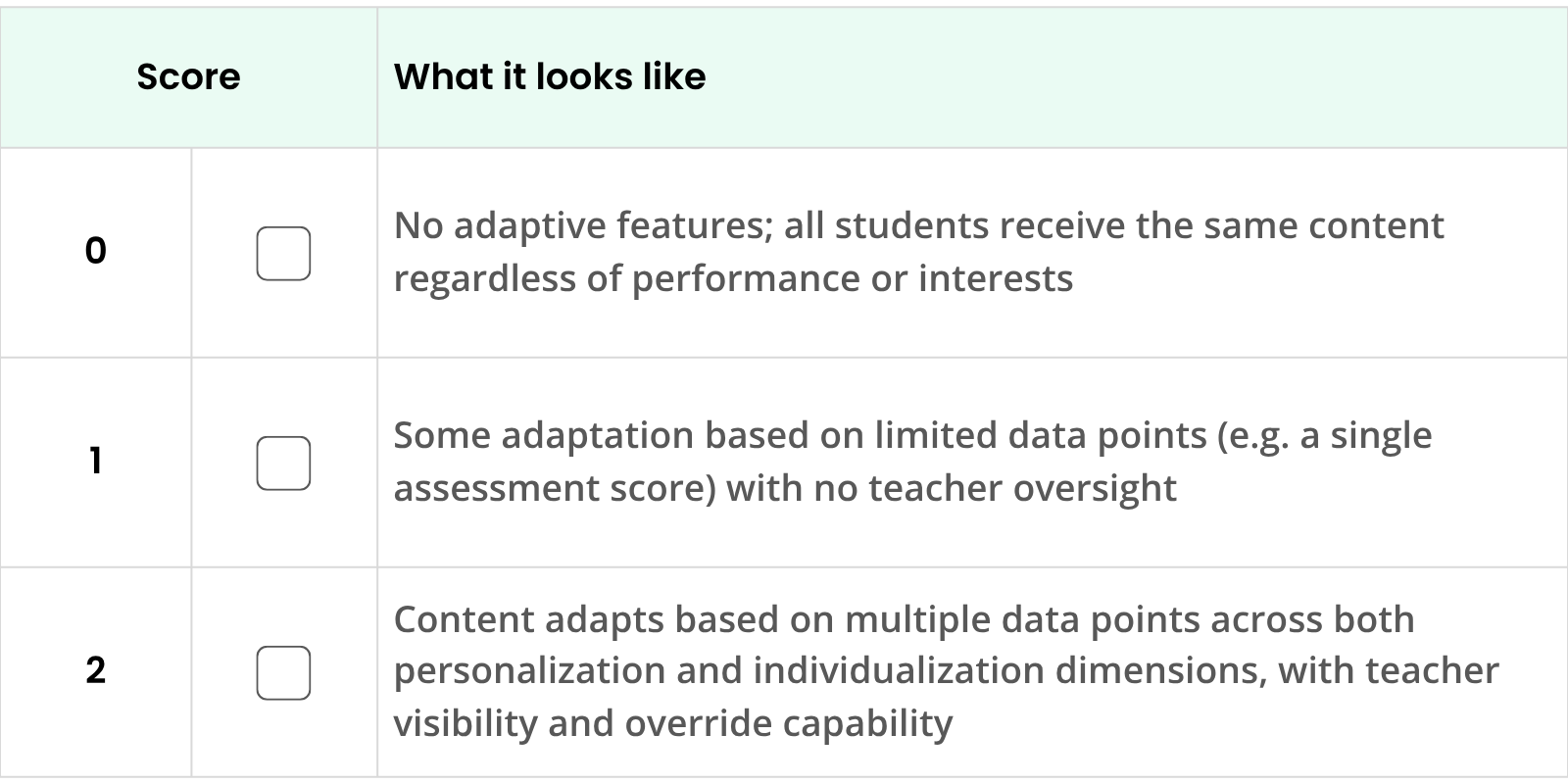
Personalized learning has been a buzzword in EdTech for over two decades, and the implementation often falls short of the promise. The term is also frequently conflated with individualized learning, but they're not the same thing. Personalized learning adapts to a student's interests, goals, and motivations. Individualized learning adapts to their pace, skill level, and gaps. A genuinely effective LMS should do both.
Showing students a slightly different reading passage based on a single quiz score is not the same thing as genuinely individualized instruction. Real individualization requires a system that draws on multiple data points: performance trends, skill gaps, learning pace, prior knowledge—and uses them to present content that meets a student where they are. It also requires that teachers remain in control of that process, so they can apply professional judgment rather than simply deferring to algorithmic recommendations.
When evaluating this feature, go beyond the marketing language. Ask: what signals does the system use to adapt content? How transparent is the logic? Can teachers review and override recommendations? A platform that can answer these questions clearly is more likely to deliver meaningful individualization in practice.
Rubric item:
Does this LMS adapt to both student interests and goals (personalized) and their pace and skill gaps (individualized), or does it treat them as the same thing?
4. Evidence-Based Instructional Design Tools for K-12
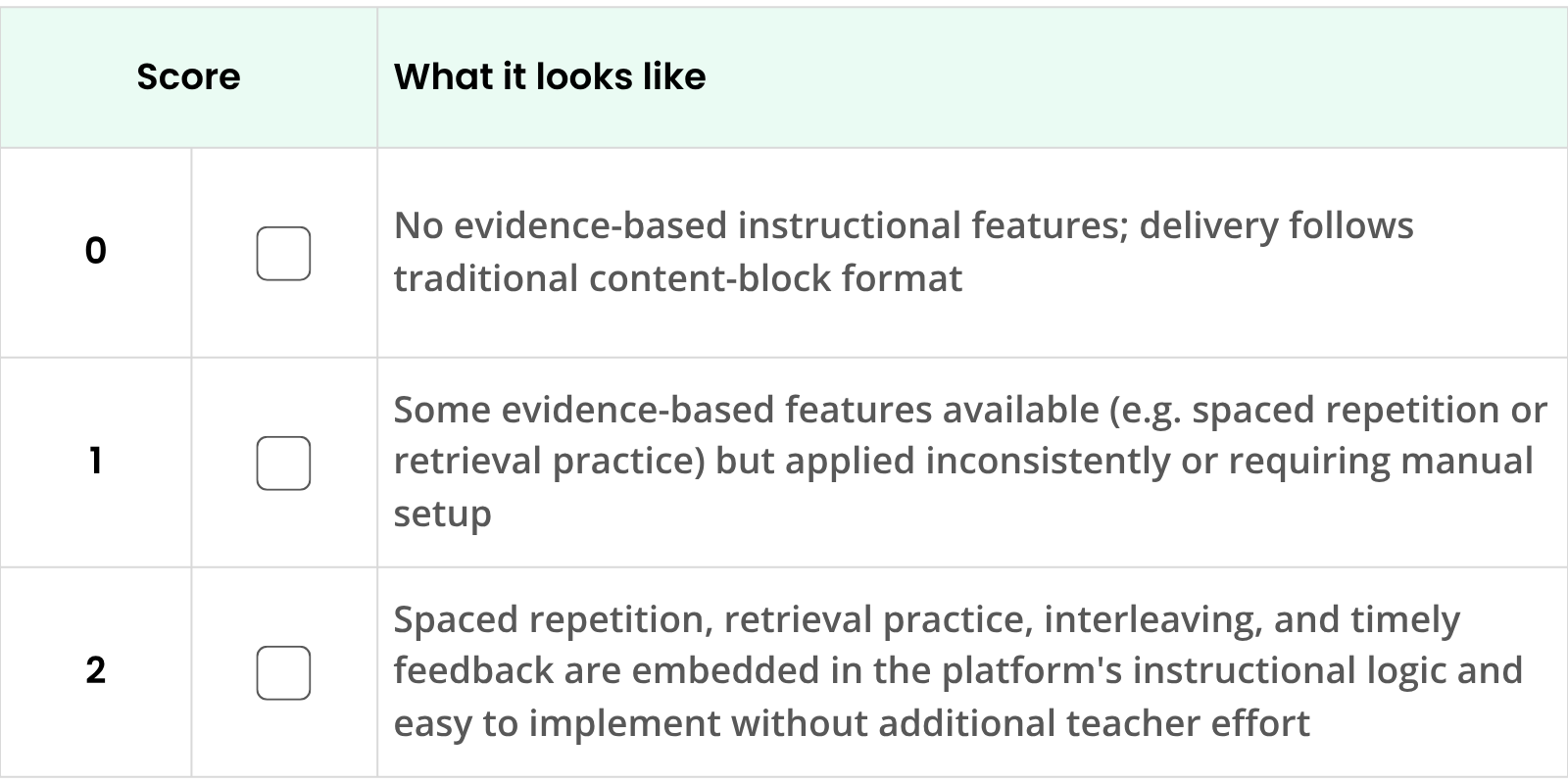
The neuroscience of learning has advanced considerably in recent decades, but much of it hasn't made its way into standard instructional design. Students still encounter content delivered in long, undifferentiated blocks, assessments timed without regard for cognitive load, and feedback that arrives too late to be useful for memory consolidation.
An LMS can either reinforce these patterns or push against them. Features that support spaced repetition, retrieval practice, interleaving, and timely feedback are grounded in robust evidence about how memory and understanding develop. An LMS that makes these approaches easy to implement, rather than requiring teachers to engineer them manually, has a meaningful edge when it comes to learning outcomes.
This is harder to evaluate than most features because it requires looking at the underlying instructional logic of the platform, not just its surface-level tools. The effort is worth it, because instructional quality compounds: a platform that nudges teachers toward evidence-based practices will gradually raise the quality of learning across an entire school or district.
Rubric item:
Does this LMS make evidence-based instructional strategies easy to implement, or does it leave teachers to engineer them manually?
5. AI-Powered Learning Tools Beyond Content Generation
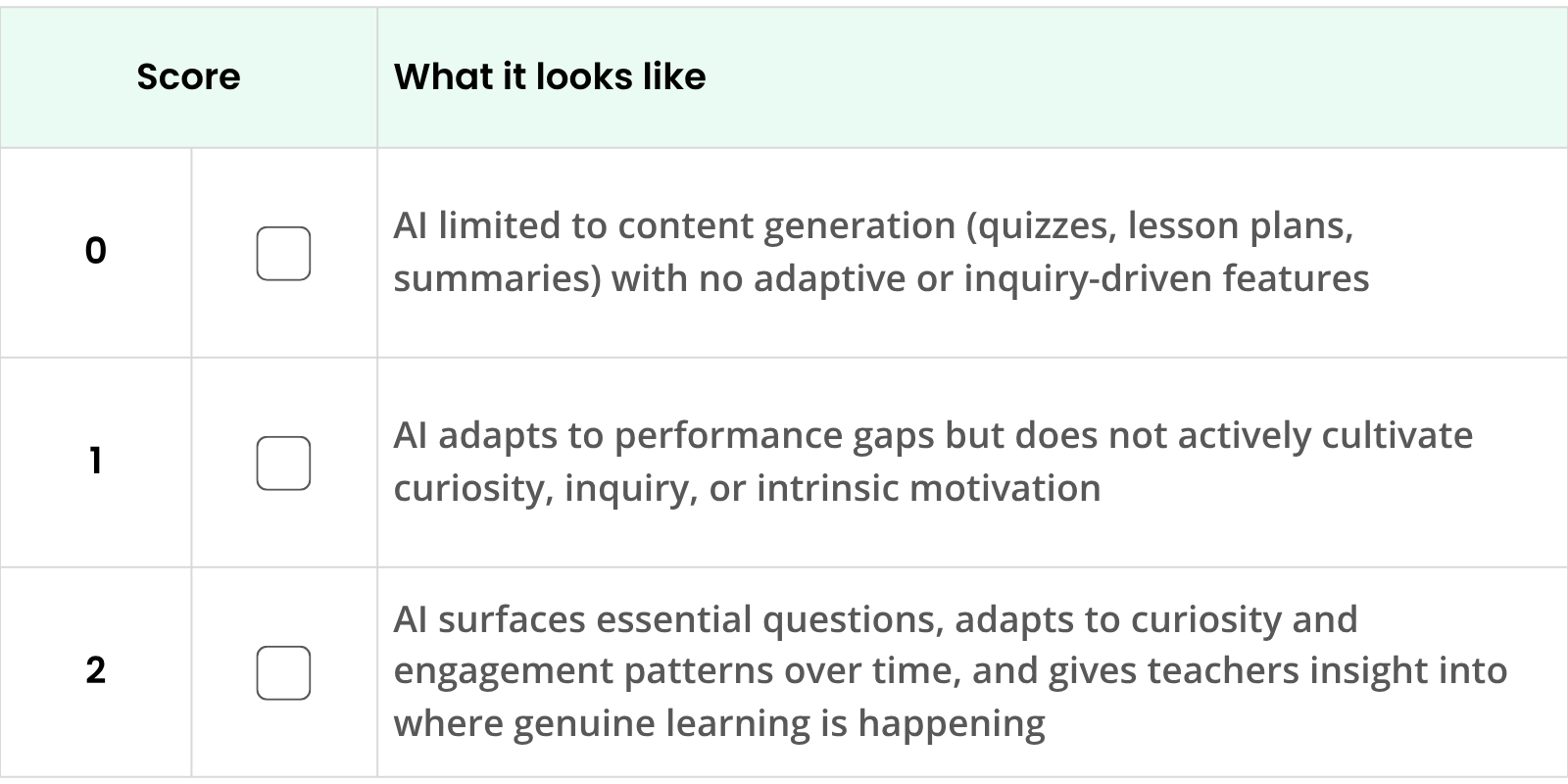
The current wave of AI in education has produced a lot of tools that generate content quickly. That's useful, but it's also the least interesting thing AI can do in a learning environment. The more important question is whether AI can make students genuinely want to learn.
Curiosity has a measurable neurological basis. Research in cognitive neuroscience consistently links it to stronger memory consolidation, deeper processing, and greater intrinsic motivation. An LMS that uses AI to spark and sustain inquiry through essential questions, adaptive challenges, and conversational nudges that prompt students to think is doing something categorically different from one that uses AI to generate a quiz in seconds.
Ask not just what the AI can produce, but what it can provoke. Does it surface questions that make students uncomfortable in productive ways? Does it adapt to a student's curiosity patterns over time, not just their performance gaps? Does it give teachers insight into where genuine engagement is happening, and where it isn't?
Rubric item:
Does this LMS use AI to provoke curiosity and deepen inquiry, or primarily to generate and deliver content?
6. Accessibility and Inclusive Design in K-12 LMS Platforms
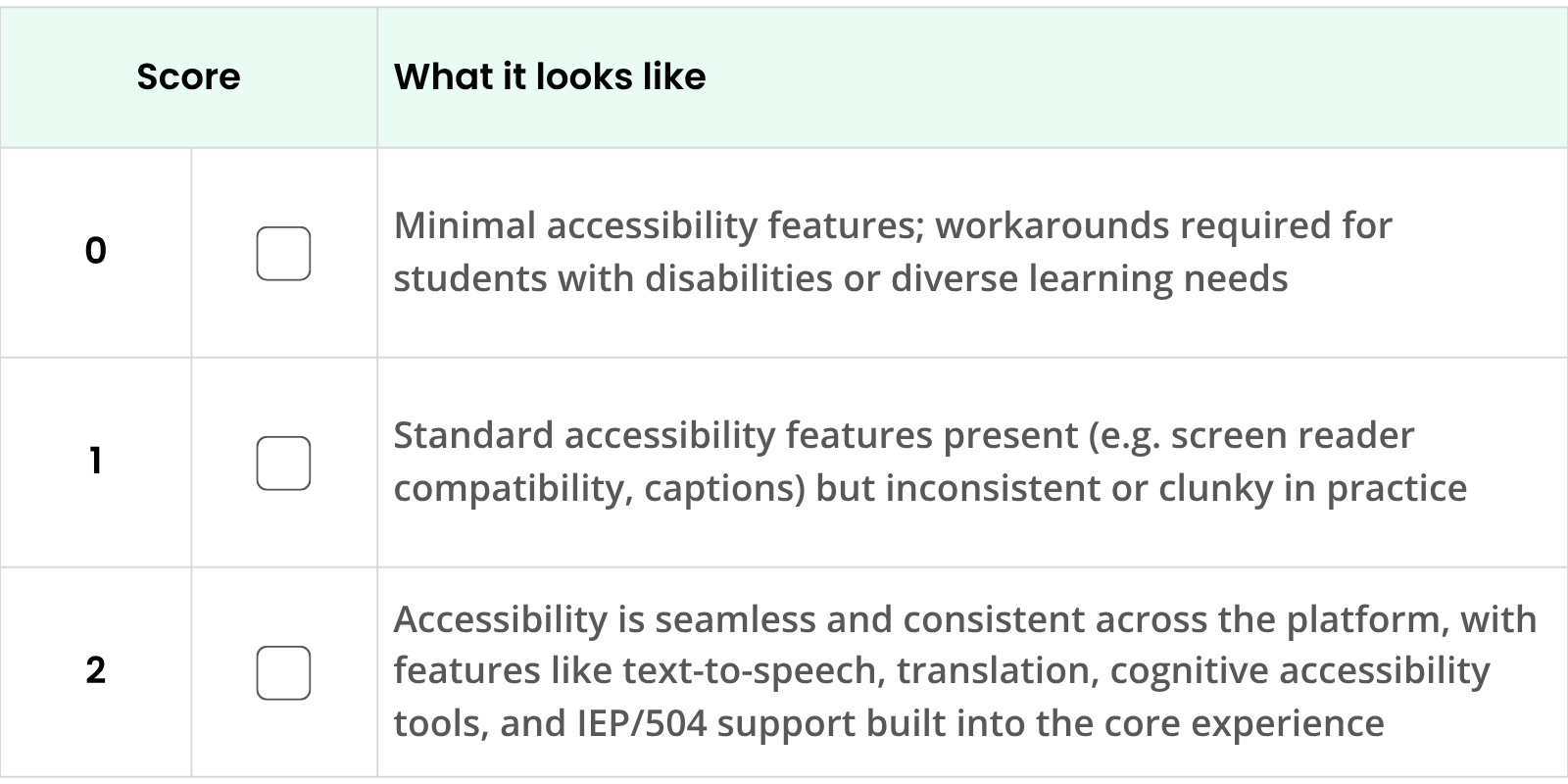
Accessibility features added late in a platform's development tend to feel like exactly that: additions. Screen reader compatibility is technically present but clunky. Caption quality is inconsistent. Navigation for students with motor differences requires workarounds.
Accessibility built into the design from the beginning is seamless, consistent across the platform, and often benefits all users, not just those with identified disabilities. High-contrast modes, adjustable text sizing, keyboard navigation, and cognitive accessibility features like simplified views or predictable layouts reduce friction for everyone.
For K-12 leaders, this matters both ethically and practically. A platform that excludes or disadvantages any group of learners cannot genuinely claim to be outcome-focused, regardless of what it offers the majority.
Rubric item:
Does this LMS treat accessibility as a core design principle, or as a set of features added after the fact?
7. LMS Reporting and Learning Analytics Tools
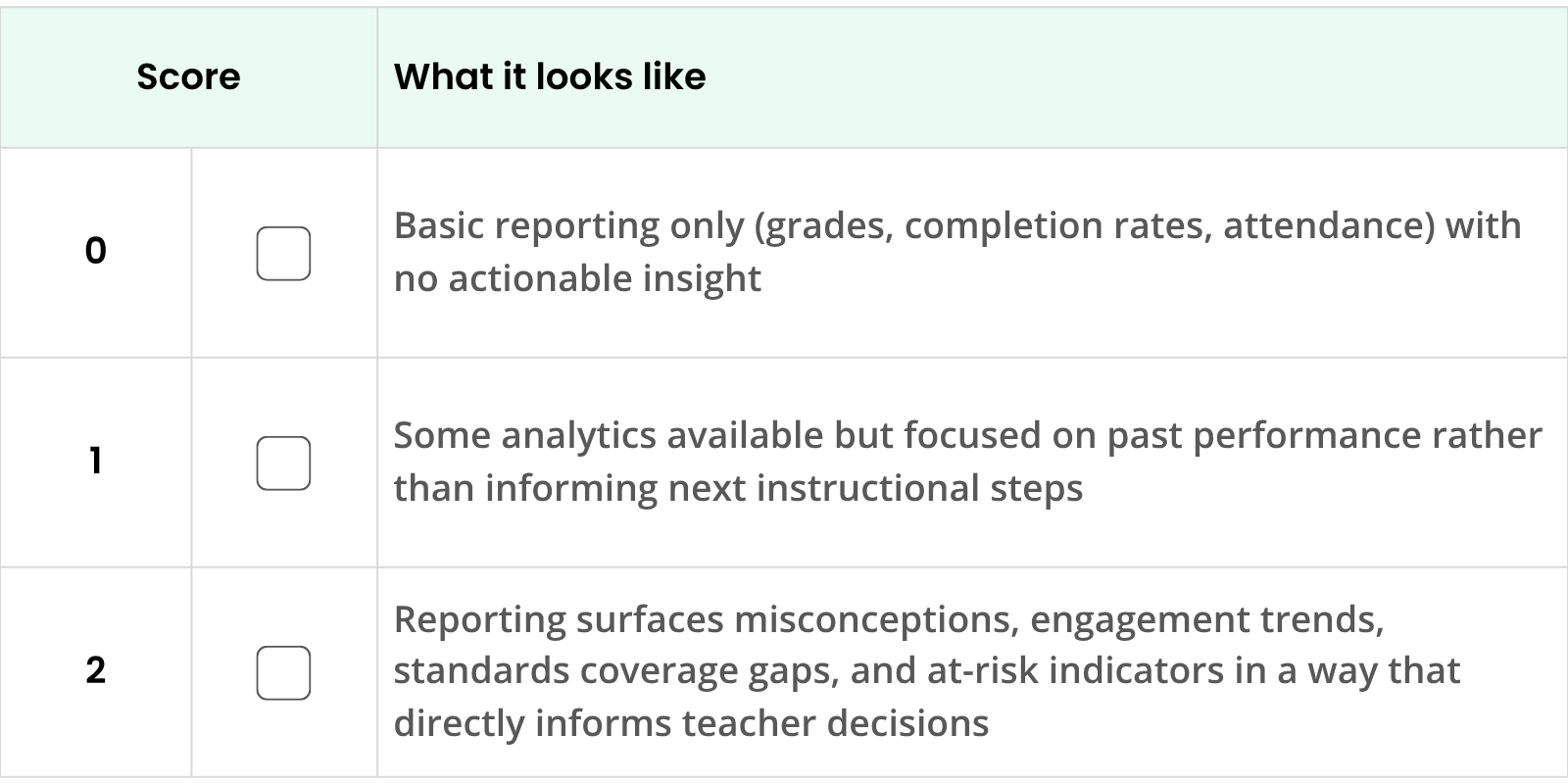
Reporting dashboards are nearly universal in modern LMS platforms. What's less common is reporting that translates directly into decisions a teacher or administrator can act on.
There's a meaningful difference between a dashboard that tells you 62% of students passed a quiz and one that tells you which specific misconception caused most of the errors, which students are at risk of falling behind based on engagement trends, or where the current unit has coverage gaps relative to the standards it was designed to address.
The metric that matters is how precisely it can identify what went wrong, for which students, and why—and surface that information in time to act on it.
Rubric item:
Does this LMS produce reports that change what a teacher does next, or reports that simply confirm what already happened?
Choosing With Outcomes in Mind
The LMS market is full of platforms that are functional, well-supported, and reasonably easy to use. Narrowing the field based on those criteria will get school leaders to a short list, but it won't necessarily surface the platform most likely to move the needle on student learning.
Evaluating against the features above shifts the selection process toward what matters most: a system built around how students learn, that gives teachers the tools and insight to act on that understanding, and that treats skills, equity, and evidence-based practice as foundational rather than optional—and that's the kind of platform worth the investment.

Dr. Joy VerPlanck holds a Doctorate in Educational Technology and a Master of Science in Organizational Leadership. She has over two decades of experience in instructional design and behavioral science, having helped develop practical solutions at the intersection of people and technology. Joy often writes about cognitive load and creativity as levers to enhance performance.