Expert Panel on Social Robots: Practical Takeaways for Education Leaders


When a social robot becomes a student’s consistent source of encouragement, feedback, or emotional support, what are the implications for human relationships, brain development, and the culture of school?
Where do we draw the line between technology that supports human development and technology that replaces essential human connection?
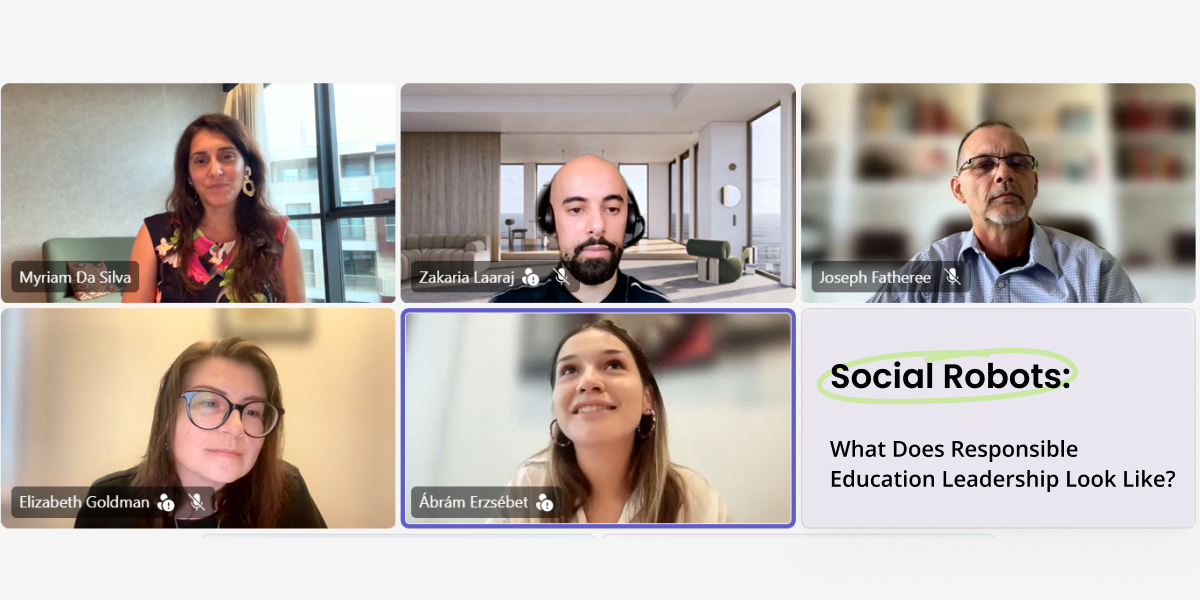
These questions recently brought together a group of experts in AI, human cognition, psychology, cultural intelligence, and behavior analysis, whose unique perspectives shaped our recent panel discussion. Led by CheckIT Learning’s CEO, Myriam Da Silva, the session explored both the risks and opportunities for education in an increasingly robotic world, offering actionable guidelines on responsible AI implementation.
The panelists unwrapped the different dimensions of this conversation, highlighting key considerations for education leaders. Their diverse backgrounds helped make the conversation layered, insightful, and above all actionable:
- Zakaria Laaraj, Cultural Intelligence (CQ) Practitioner
- Erzsébet Ábrám, Behavior Analyst and Emerging Impact Practitioner (recent graduate from the Columbia University)
- Elizabeth Goldman, Ph.D., Assistant Professor of Psychology and the Director of the Children and Technology Lab
- Joseph Fatheree, Author, Educator, and Filmmaker
Intro: How Teens are Using AI
The use of AI companions among students is rapidly increasing. Recent research by Sameer Hinduja and Justin W. Patchin reveals that 6 in 10 teenagers have used a companion AI at least once. Among them, over 60% seek advice or guidance, as well as friendship and companionship. Nearly half turn to it for emotional support and mental health issues, while slightly over 30% use it for romantic interactions.
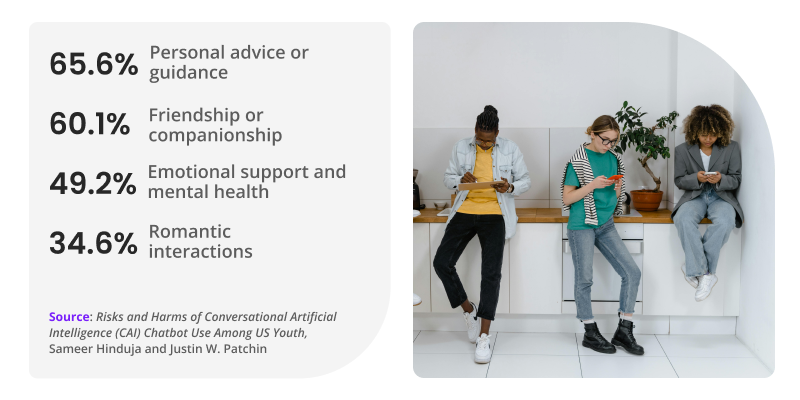
These trends indicate that AI is already shaping student behavior, relationships, and expectations. The challenge for education leaders is to identify and understand the signals that reveal how these tools impact students' school lives and social connections.
“Where you usually would have to go through a series of interactions with other people that you might disagree with, where your perceptions are going to be challenged, now there's an AI system, which might be biased”, says Zakaria Laaraj. “If more than 60% of teens are using companion AI, we should ask ourselves whether it is going to help us to develop the diversity and also the intellectual diversity that comes through learning and the exchange of different perspectives. And therefore, AI has a very important role.”
“From our research we know that even young children will attribute thoughts, feelings and intentions to robots, AI, and other types of smart technology. AI is consistently providing this instant validation, agreements, emotional responsiveness, and it can start really shaping our expectations and our relationships”, adds Elizabeth Goldman. “So for thinking about things to watch out for, I would say overreliance on AI for social or emotional support.”
AI and Human Relationships Development
As AI companions become increasingly capable of providing encouragement, validation, and emotional support, the nature of human relationships is changing. This behavioral and relational dimension of AI adoption remains largely overlooked compared to the heavy focus on cognitive development and academic integrity in current tech discussions.
Dr. Joseph Fatheree tackled the question of AI's impact on human relationship development, drawing on his research to shed light on the essential issues we need to consider.
“It’s harder to be in a relationships where we constantly push each other back. [] And I think we’re the last generation in human history that ever look at relationships the way all of humanity has before them.”
Dr. Fatheree emphasized that before we allow the nature of human relationships to change, we must critically examine the potential side effects. Special focus should remain on children and young people, who are at the greatest risk of this change, yet who have no say in this conversation and no awareness of its impact. This is why education leaders and policymakers need to get together to address these essential issues and develop protections for the groups who are most at risk.
Student Voice: How to Integrate it into Decision Making
One area policymakers and education leaders tend to overlook when discussing AI frameworks and implementation strategies is the students' own voices. Exploring how teenagers actually use AI and what their expectations are can provide invaluable insights into implementation best practices.
To ensure the student voice was represented on our panel, we invited Erzsébet Ábrám, a Behavior Analyst and Emerging Impact Practitioner who recently graduated from Columbia University. Her insights provided an essential dimension to the conversation, unveiling real-world AI use cases and the immediate impacts these tools are having on student relationships.
“I think it’s very important to acknowledge that we need community spaces where people feel empowered to express their thoughts, even if they are professionals or educators with multiple years of experience. The world is changing and we’re in this together.”
She further emphasized the importance of AI literacy and creating building blocks for developing emotional intelligence in students. Empowering students to develop critical thinking and the awareness that there might be multiple truths, rather than overthinking everything, is a critical step toward responsible and productive use of AI.
Action Items for Educational Leaders
Developing frameworks for the responsible and ethical use of AI is a priority for a variety of organizations looking to drive educational transformation. However, many education leaders struggle to understand how to translate these broad principles into day-to-day practice within their schools and districts.
To address this, our panelists shared key action items that education leaders can immediately implement to navigate AI adoption in a responsible, impactful way.
- Co-create strategies with your community: Leverage established frameworks, but tailor them to address the specific, real-world needs of your local community.
- Define clear boundaries for AI use: Take a proactive stance on what roles AI should and shouldn't play to prevent drifting into unintended use cases.
- Empower students through critical thinking: Integrate AI literacy directly into your existing digital literacy conversations.
- Build organizational capacity in stages: Start with foundational "AI 101" awareness for all staff members before establishing a governance committee that reflects diverse perspectives.
- Integrate emotional intelligence into the dialogue: Host roundtable discussions that intentionally bring together individuals from different backgrounds to explore diverse opinions.
Ready to dive deeper? The full recording is available via this link. Feel free to share it with fellow education leaders who are navigating AI implementation best practices!

A team of marketing and communication specialists exploring the incredible potential of neuroscience and AI in education.