Emotions of Learning and How to Use Them to Teach More Effectively Part 2: Emotions That Broaden and Sustain Learning


By Dr. Staci Lorenzo Suits
In Part 1 of this series, we explored how surprise, curiosity, interest, and productive confusion and frustration can help students engage more deeply with challenging academic work. In this second part, we turn to the emotions that broaden and sustain learning over time: delight, joy, and awe, as well as confidence, pride, and purpose. We will also consider important cultural factors that shape how emotions show up in classrooms and conclude with a practical planning checklist you can use to intentionally weave all four emotion clusters into your daily instruction.
Emotions that Broaden Learning: Delight, Joy, and Awe
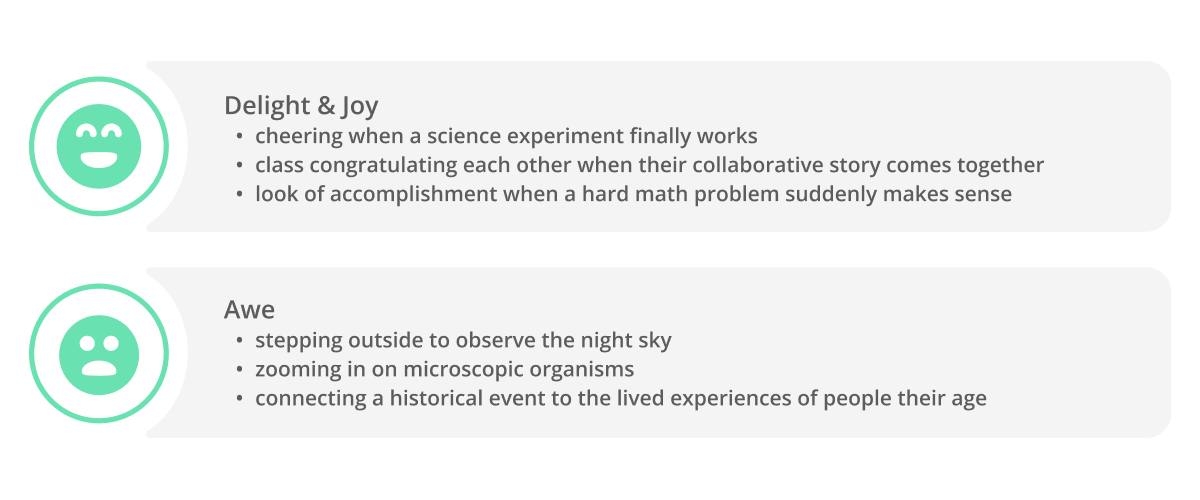
Enjoyment and excitement about learning can increase attention to the material and support the experience in which students are deeply immersed in a task (Pekrun, 2014). In learning, delight and joy are not just about students having a fun lesson; they are the natural payoff of the deeply satisfying “aha” moment when understanding clicks and feels worth the effort. In the classroom, joyful learning might look like a student cheering when a science experiment finally works, a class congratulating each other when their collaborative story comes together, or a look of accomplishment when a hard math problem suddenly makes sense. These joyful experiences support students in becoming lifelong learners who associate effort and persistence with genuine satisfaction, which is the real goal of education.
Awe, which relates to an appreciation for beauty, vastness, or wonder, is another emotion that can have powerful effects on learning. Awe often arises when students encounter something that feels bigger than themselves or challenges their usual way of seeing the world, such as watching a time-lapse of galaxies forming, hearing a piece of music that gives them chills, or reading about a person who showed extraordinary courage or kindness. Research shows that science teachers use awe-invoking experiences to facilitate student learning and inspire interest in the subject matter (Jones et al., 2022). In practice, this might look like stepping outside to observe the night sky, zooming in on microscopic organisms, or connecting a historical event to the lived experiences of people their age to help students feel a sense of wonder and significance.
When delight, joy, and awe are intentionally built into instruction, they do more than make class time enjoyable. They broaden students’ thinking, help them see connections across ideas and disciplines, and strengthen the emotional memory traces that make learning stick and feel meaningful over time.
Teaching Strategies to Support Delight and Joy
- Use storytelling, humor, and student interaction to bring concepts to life, such as telling a short personal story about a time you struggled and then felt proud of mastering a skill.
- Design collaborative tasks where students create something together, like a class podcast, a shared mural, or a group experiment, so they can experience the shared joy of producing a meaningful product.
- Engage multiple senses during learning by incorporating visuals, movement, manipulatives, music, or simple hands-on materials to make abstract ideas feel more vivid and enjoyable.
- Build in small moments of celebration when students reach milestones, such as a quick class cheer, a “wow wall” for student work, or a one-sentence shout-out that recognizes effort and growth.
- Make time for short reflective prompts where students identify moments that felt satisfying, surprising, or fun in their learning, helping them notice and name the joy that comes from hard work paying off.
Teaching Strategies to Support Awe
- Intentionally slow the pace at key moments and invite students to pause, look closely, and sit with what they are seeing or hearing, such as watching a powerful video clip twice or revisiting a compelling image.
- Engage the senses with “wow” experiences, like showing high-quality nature or space footage, playing a moving piece of music, or examining unusual objects, and then asking students what feels amazing or hard to wrap their minds around.
- Leverage nature and big systems by taking learning outdoors when possible, growing plants in the classroom, collecting natural objects, or using visuals to explore cycles, ecosystems, or the scale of the universe.
- Harness storytelling and “moral beauty” by sharing stories, myths, biographies, or current events that highlight courage, kindness, creativity, or perseverance, and inviting students to reflect on why those moments move them.
- Create simple reflective rituals, such as brief class discussions, “awe journals,” or exit tickets where students record something that gave them a sense of wonder that day, reinforcing that these feelings are an important and valued part of learning.
Emotions that Continue Learning: Confidence, Pride, and Purpose
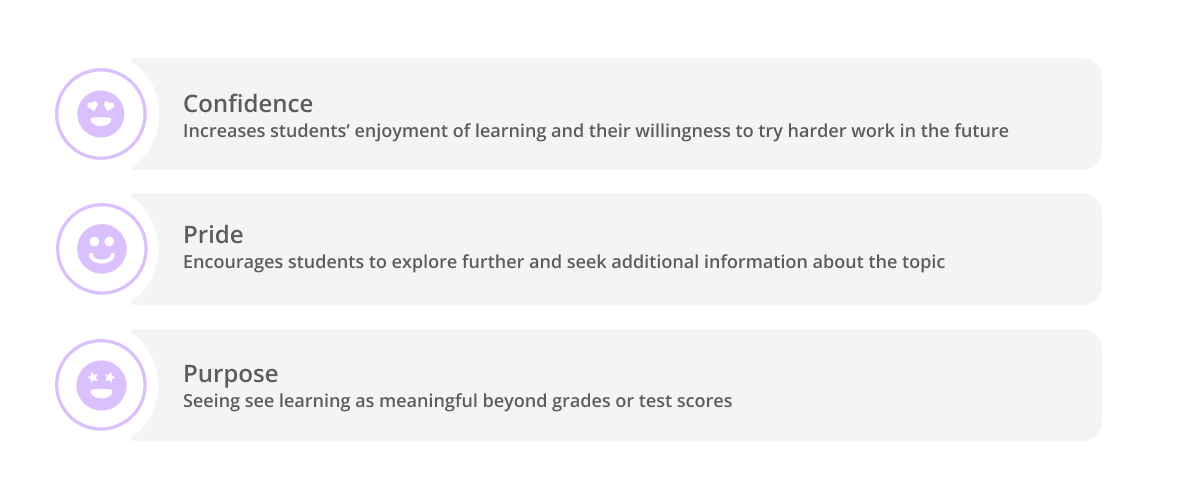
Emotions like confidence, pride, and purpose help determine what happens after a lesson ends. They shape whether students choose to revisit ideas, take on new challenges, and see themselves as capable learners over time. Self-confidence involves students feeling successful in their ability to complete academic tasks, which can increase their enjoyment of learning and their willingness to try harder work in the future (Pekrun, 2014; Pekrun, 2024). In the classroom, this might look like a student who used to say “I’m bad at math” beginning to tackle multi-step problems without immediately asking for help, because they now have a track record of getting through hard things.
Pride is closely related but slightly different. It is the feeling that comes from recognizing one’s own progress or accomplishment and being able to say, “I did that.” Research shows that students who feel pride after correctly answering problems are more likely to explore further and seek additional information about the topic (Vogl et al., 2020). A student who feels proud of improving their reading level might start choosing more challenging books, or a student who successfully presents a project to the class might ask for another opportunity to share their ideas. When pride is grounded in effort, strategies, and growth rather than perfection or comparison, it becomes a powerful fuel for ongoing learning.
Purpose adds a longer-term dimension. It is the sense that what students are learning connects to their values, goals, or the kind of person they want to become. A sense of purpose can develop when a student realizes that learning to write clearly helps them advocate for themselves, that understanding science allows them to care for the environment, or that practicing a second language connects them to their family or community. When students see learning as meaningful beyond grades or test scores, they are more likely to persist through setbacks because the work feels worth the effort.
When we intentionally design for confidence, pride, and purpose, we are not aiming for constant praise or perfect products. Instead, we are helping students see their progress, name the strategies that helped them grow, and connect their learning to something that matters beyond the current assignment.
Teaching Strategies to Support Confidence
- Make progress visible by using simple checklists, charts, or “before and after” samples that show what students can do now that they could not do a few weeks ago.
- Break larger tasks into clear, manageable steps so students can experience small wins along the way and build a sense of “I can do this” rather than feeling overwhelmed from the start.
- Offer guided practice with gradual release, moving from “let’s do this together” to “you try it with a partner” to “you try it on your own,” so students experience success at each stage.
- Use language that emphasizes capability and growth, such as “You are getting better at…” or “You used a new strategy today,” instead of labels like “You are smart” that feel fixed.
- Give students chances to revisit and improve earlier work so they can literally see their own improvement and start to trust that effort leads to progress.
Teaching Strategies to Support Pride
- Provide specific feedback that links what the student did to why it worked, such as “You organized your ideas with clear headings, which made your explanation easier to follow.”
- Celebrate strategy and persistence rather than speed or perfection by commenting on how students tried different approaches, revised their thinking, or stuck with a challenge.
- Build shareable artifacts, such as mini-posters, audio explanations, or short demo videos, so students can teach others and feel proud of contributing to the classroom community.
- Create opportunities for students to showcase their work through gallery walks, brief presentations, or peer sharing where classmates leave “I noticed…” and “I admire…” comments.
- End units or projects with a short reflection where students identify one thing they are proud of, what it took to achieve it, and how that accomplishment changes what they believe they can do next time.
Teaching Strategies to Support Purpose
- Connect each unit or major task to a real-life question, problem, or role that matters to students, such as helping a younger student, improving the school, or understanding an issue in their community.
- Invite students to set personal learning goals and briefly explain why those goals matter to them, then revisit these goals during and after the unit to reinforce a sense of direction.
- Design occasional assignments where the audience is someone beyond the teacher, such as a letter to a local official, a how-to guide for younger students, or a product for a community display.
- Use short discussions or journal prompts that ask students how today’s learning could be useful in their future, in their hobbies, or in the kind of person they want to become.
- Highlight examples of people using similar skills or knowledge in meaningful ways in the real world, and explicitly connect classroom tasks to those stories so students see a line between their work and a larger purpose.
Important Cultural Considerations
Important cultural considerations include recognizing that emotions are expressed, interpreted, and valued differently across cultures, communities, and families, which means there is no single right way for students to show curiosity, joy, confusion, or pride. Some students may have been socialized to be quiet and deferential with adults, so their engagement might look like careful listening and thoughtful note-taking rather than enthusiastic discussion, while others may show interest through animated talk and movement. Similarly, open displays of frustration or confusion may be discouraged in some homes or prior school experiences, leading students to hide these emotions rather than seek help. Teachers should be cautious not to misinterpret cultural communication styles or language differences as lack of motivation or ability and should invite multiple ways for students to participate (writing, drawing, talking in small groups, using first languages, etc.). Building trust with families, learning about students’ cultural backgrounds, and explicitly normalizing a range of emotional responses to learning can help create a classroom where all students feel safe to engage, struggle, and take pride in their progress without feeling that their way of “showing up” is wrong.
Conclusion
When we design lessons with emotions in mind, we move from hoping students will be engaged to intentionally engineering the conditions that make engagement, persistence, and deep understanding more likely. Surprise, curiosity, and interest open the door to learning; productive confusion and frustration help students wrestle with complexity; delight, joy, and awe broaden their sense of what is possible; and confidence, pride, and purpose carry the learning forward long after the bell rings. None of this requires turning every lesson into a performance—rather, it means making small, thoughtful moves in planning and instruction so that students’ emotional lives are seen as an essential part of how they think and learn, not an optional extra. As you plan your next unit or lesson, you might use the self-reflection questions below as a quick lens: not to add more to your plate, but to help you get more learning value from the work you are already doing.
Reflective Planning Questions to Incorporate Emotions of Learning into Lessons
- To Engage Students – Facilitate Surprise, Curiosity, and Interest: What specific question, anomaly, choice, or real-world hook will I use to trigger curiosity, surprise, or interest in the first few minutes of the lesson?
- To Deepen Learning – Support Productive Confusion and Frustration: Which step is most likely to feel “sticky,” and what scaffold or hint ladder will I provide so students can work through confusion instead of shutting down?
- To Broaden Learning – Nurture Delight, Joy, and Awe: Where in this lesson can I intentionally pause for a designed moment of delight or awe that helps students feel wonder, make connections, and see the bigger picture of what they are learning?
- To Continue Learning – Foster Confidence, Pride, and Purpose: How will each student experience an authentic success, name at least one effective strategy they used, and connect today’s work to a purpose or goal that matters to them beyond the grade?
- Consider Culture – Honor Diverse Emotional Expressions and Needs: Have I built in multiple ways for students from different cultural and linguistic backgrounds to participate, express emotion, and show understanding so no one’s quieter or different style of engagement is misread as disinterest or inability?
References
Jones, M. G., Nieuwsma, J., Rende, K., Carrier, S., Refvem, E., Delgado, C., Grifenhagen, J., & Huff, P. (2022). Leveraging the epistemic emotion of awe as a pedagogical tool to teach science. International Journal of Science Education, 44(16), 2485–2504. https://doi.org/10.1080/09500693.2022.2133557
Pekrun, R. (2014). Emotions and learning (Educational Practices Series No. 24). International Academy of Education & International Bureau of Education. Retrieved November 5, 2025, from http://www.iaoed.org/downloads/edu-practices_24_eng.pdf
Pekrun, R. (2024). Control-value theory: From achievement emotion to a general theory of human emotions. Educational Psychology Review, 36, Article 83. https://doi.org/10.1007/s10648-024-09909-7
Vogl, E., Pekrun, R., Murayama, K., & Loderer, K. (2020). Surprised-curious-confused: Epistemic emotions and knowledge exploration. Emotion (Washington, D.C.), 20(4), 625–641. https://doi.org/10.1037/emo0000578
This article was crafted by Dr. Staci Lorenzo Suits, an independent contributor engaged by CheckIT Labs, Inc. to provide insights on this topic.

Staci holds a doctorate in school psychology and diplomate status in school neuropsychology. She specializes in strength-based school neuropsychological evaluations and is especially passionate about strength-based neurodiversity-affirming practices, student self-advocacy, family engagement, and addressing educator burnout and retention.