Desirable Difficulties: The Best Learning Feels Hard


By Rashawn Davis
Imagine two classrooms.
In the first classroom: students move through a lesson with ease. The teacher explains a concept, students copy notes, complete similar practice questions, and leave feeling confident about what they have learned.
In the second classroom: the experience feels very different. Students begin the lesson by recalling material from previous weeks without looking at their notes. They explain their reasoning to classmates, solve a mixture of old and new problems, and revisit concepts they thought they had already mastered. The lesson feels slower, more demanding, and students make more mistakes along the way.
Although many students would prefer the first classroom, research suggests that the second classroom is more likely to produce lasting learning.
Effective learning is not always about making tasks easier.
In fact, some of the most powerful teaching practices intentionally make learning more challenging. These challenges, known as ‘desirable difficulties’ or ‘productive struggle’, require students to think harder, retrieve knowledge from memory, and apply their understanding in new ways. While these approaches may feel more difficult in the moment, they help students build stronger memories and develop deeper understanding.
What Is Evidence-Based Teaching?

Evidence-based teaching focuses on using instructional approaches supported by research from cognitive science, educational psychology, and classroom studies. Rather than relying on educational trends or assumptions about how students learn best, evidence-based practices are designed around how the brain processes, stores, and applies information.
The Australian Education Research Organisation (AERO) explains that effective teaching is not simply about presenting information to students. Learning occurs when students actively engage with new knowledge, connect it to what they already know, and practise applying it over time.
A key principle of evidence-based teaching is that teachers should carefully balance support and challenge. Students need clear explanations, structured guidance, and opportunities to practise before they can successfully work independently. This is why approaches such as explicit instruction are important. Teachers model new skills, explain concepts clearly, provide worked examples, and gradually reduce scaffolding as students become more confident.
This process helps manage cognitive load, which refers to the limited amount of information the brain can process at one time. When students are introduced to too much new information without enough guidance, their working memory can become overwhelmed. Effective teaching reduces unnecessary cognitive load by organising learning carefully while still creating opportunities for students to engage in meaningful thinking.
The goal is not to remove difficulty from learning, but to remove unnecessary barriers while creating productive challenges that strengthen learning. Strategies such as retrieval practice, spaced practice, interleaving, and elaboration all make learning more effortful but also more efficient.
Retrieval Practice: Learning by Remembering
One of the most effective evidence-based strategies is retrieval practice. Instead of repeatedly reviewing information, retrieval practice requires students to recall knowledge from memory.
Many students believe that rereading notes or highlighting important information helps them learn because the material becomes familiar. However, familiarity does not always mean understanding. A student may recognize information when looking at notes but struggle to recall or apply it later.
Retrieval practice strengthens learning because it forces students to reconstruct knowledge actively. Each time students successfully retrieve information, they strengthen the memory pathway that allows them to access that knowledge in the future. Even when students struggle to remember something, the process helps identify gaps in understanding and creates opportunities for correction.
Teachers can incorporate retrieval practice through:
- Low-stakes quizzes
- Exit tickets
- Questioning at the beginning of lessons
- Brain-dump activities where students write everything they remember
- Asking students to explain concepts without using notes
The purpose of retrieval practice is not simply assessment. Instead, it is a learning activity that helps students build stronger and more accessible knowledge.
Spaced Practice: Revisiting Learning Over Time
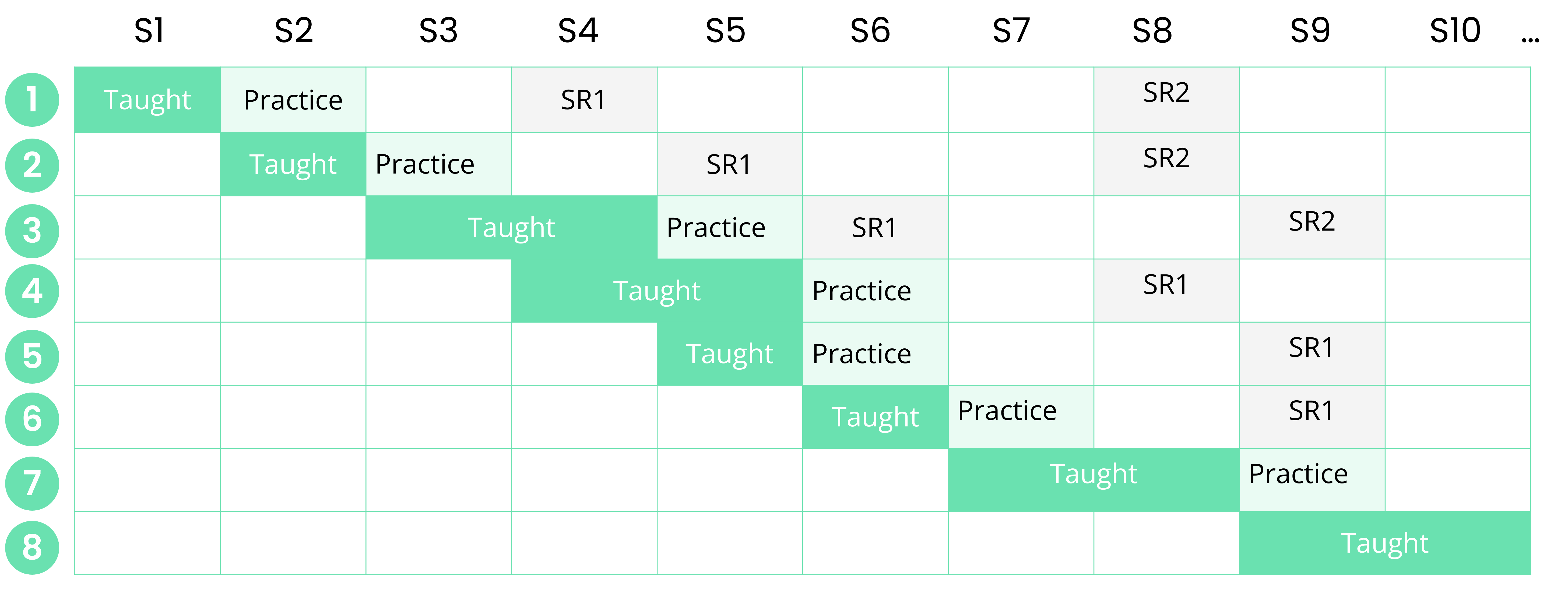
Download a sample lesson plan that integrates spacing and retrieval practice.
Another powerful strategy is spaced practice, which involves revisiting learning over extended periods rather than concentrating all practice into one session.
Many students rely on cramming before exams because it creates a temporary sense of confidence. However, much of this information is quickly forgotten. Spacing learning across days, weeks, and months allows students to strengthen their understanding by repeatedly rebuilding knowledge after some forgetting has occurred.
Although spacing may feel less efficient because students must review information multiple times, it creates stronger long-term retention. Each review requires students to retrieve information again, thus incorporating the retrieval practice and reinforcing connections in memory.
Teachers can use spaced practice by:
- Beginning lessons with review questions from previous units
- Including older material in new assignments
- Using cumulative assessments
- Revisiting important concepts throughout the year
- Spreading a concept throughout multiple units
As a language teacher, I rely heavily on spaced practice and have utilised all of the above in some capacity. Walking into my classroom at the beginning of class, one can expect to see students answering the para empezar (do now) that’s based on a previous lesson. During my Unit 3, one can expect to see me prompting students to use their vocabulary sheets or sentence frames from Units 1 and 2.
Spacing not only allows students to revisit older material, but it also changes how students think about forgetting. Forgetting is not necessarily a sign that learning has failed. When students have opportunities to retrieve information again, forgetting becomes part of the learning process.

Interleaving: Mixing Problems to Improve Learning
Interleaving is another strategy that increases productive challenge. Instead of practicing one skill repeatedly before moving on to another, interleaving mixes different concepts or problem types together.
For example, a mathematics student completing twenty identical multiplication problems may become good at following a pattern but may not understand when multiplication is the appropriate strategy to use. Interleaving requires students to first identify what type of problem they are solving before deciding how to approach it.
This process feels more difficult because students cannot rely on repetition alone. They must compare ideas, recognise differences, and make decisions. Although students may initially make more mistakes, they develop stronger conceptual understanding and become better at transferring their knowledge to unfamiliar situations.
Examples of interleaving include:
- Mixing different mathematical operations
- Comparing historical events instead of studying them separately
- Combining grammar skills within writing activities
- Alternating scientific concepts during review
By requiring students to think before acting, interleaving prepares them for real-world situations where problems are rarely presented in predictable formats.
Elaboration and Self-Explanation
Learning becomes more meaningful when students understand relationships between ideas rather than memorising isolated facts. Elaboration and self-explanation encourage students to explain, connect, and apply their knowledge.
Students using elaboration ask questions such as:
- Why does this happen?
- How does this connect to something I already know?
- Can I explain this in my own words?
- Can I create an example?
Self-explanation requires students to describe their thinking while completing a task. This helps them identify gaps in their understanding and develop more organised mental models.
Teachers can encourage elaboration through:
- Classroom discussions
- Reflection activities
- Concept maps
- Peer teaching
- Written explanations of reasoning
These activities move students beyond memorisation and encourage deeper understanding.
Productive Struggle, Not Unnecessary Difficulty
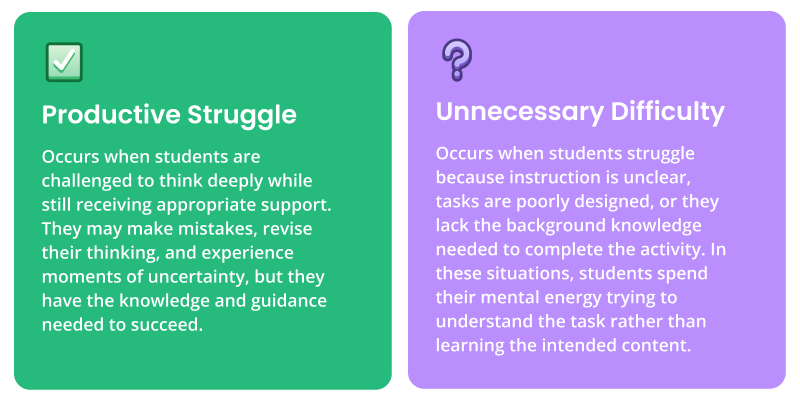
Although evidence-based teaching emphasises challenge, not all difficulty improves learning. Teachers must distinguish between productive struggle and unnecessary difficulty.
Productive struggle occurs when students are challenged to think deeply while still receiving appropriate support. They may make mistakes, revise their thinking, and experience moments of uncertainty, but they have the knowledge and guidance needed to succeed.
Unnecessary difficulty occurs when students struggle because instruction is unclear, tasks are poorly designed, or they lack the background knowledge needed to complete the activity. In these situations, students spend their mental energy trying to understand the task rather than learning the intended content.
AERO highlights that effective teaching involves sequencing learning experiences carefully. Students should first receive clear instruction and modelling before being asked to complete more complex tasks independently. Challenge should increase as students develop expertise, allowing them to experience success while continuing to grow.
Conclusion
Evidence-based teaching reminds us that learning is not measured by how easy a lesson feels in the moment. True learning is demonstrated when students can remember information, explain ideas, and apply knowledge in new situations long after instruction has ended.
Strategies such as retrieval practice, spaced practice, interleaving, elaboration, and explicit instruction work because they align with how learning actually occurs. They reduce unnecessary difficulty while increasing the productive thinking that leads to stronger understanding.
The most effective classrooms are not those where students never struggle. They are classrooms where struggle has a purpose. When teachers create carefully designed challenges, students develop deeper knowledge, stronger memory, and greater independence. Learning may feel harder, but that challenge is exactly what helps make learning last.
This article was crafted by Rashawn Davis, an independent contributor engaged by CheckIT Labs, Inc. to provide insights on this topic.

Rashawn Davis is committed to making language learning both equitable and engaging. Now in his third year of secondary teaching, Rashawn currently teaches English as a New Language (ENL) through biology, having previously taught Spanish for two years. A heritage speaker of Jamaican Patois and an avid polyglot, he brings a linguist’s precision to his practice—spotlighting neurodiverse learners, culturally responsive pedagogy, and the small, joyful habits that turn curiosity into fluency.