Improving Instructional Efficiency with Neuroscience Strategies: Success Story from Woodridge District 68, Illinois



While schools increasingly understand how educational neuroscience can boost instructional efficiency and student achievement, bridging the gap between theory and classroom practice remains a challenge.
59% of educators surveyed by YouGov in 2022 said they would need practical guidance on how to apply neuroscience strategies to lesson design, while 40% felt it would positively impact their teaching experience.
Understanding how the brain learns best helps educators effectively capture and sustain students’ attention, manage cognitive load, foster executive functioning, and activate intrinsic motivation. This transforms learning experiences from the passive reception of lesson content into a meaningful journey to success beyond the classroom.
With educational neuroscience still being largely overlooked in formal teacher training, schools are seeking alternative professional development opportunities. Woodridge School District 68 turned to CheckIT Learning’s Professional Development and Micro-Course to equip their staff with classroom-ready neuroscience strategies.

The advantages of neuroscience-based teaching
Even as cognitive science offers a growing body of evidence for the effectiveness of brain-based strategies for teaching, education largely remains tied to traditional lesson design. While individual students, teachers, and schools recognize this gap and explore modern strategies, traditional approaches to both teaching and learning remain a dominant reality.
A recent meta-analysis revealed that rereading is the preferred study method for 78% of students, while another study shows that 83.6% rely on cramming.
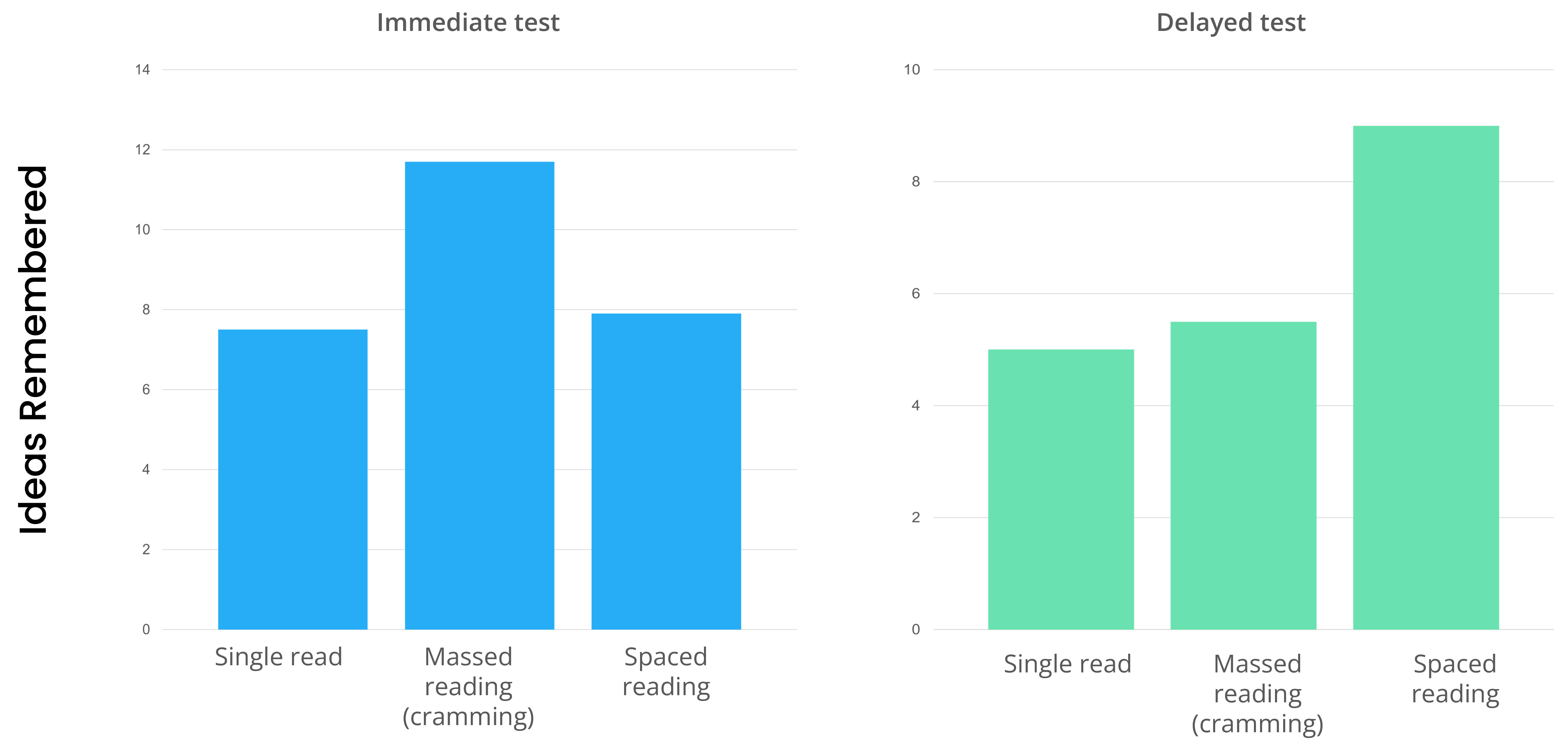
While these techniques can deliver short-term results on an immediate test, they fail to ensure long-term retention. Measurably more effective are spacing and retrieval practice, which are found to contribute to proportional performance gains of 29% on semestral exams and a 17% improvement at the end of school year.
The graphic below illustrates the evidence from Rawson and Kintsch, whose experiments proved that spaced reading helps learners retain more ideas on a delayed test.
For further details on spacing and retrieval practice watch our earlier webinar with Dr. Cynthia Nebel, Director of Learning Services at St. Louis University School of Medicine.
Science of Learning: Skills & Strategies
Spaced learning and retrieval practice are techniques whose effectiveness in the classroom is consistently proven. However, neuroscience-based teaching includes a number of additional strategies that translate psychology and cognitive science directly into classroom practice.
Some of the foundational concepts and strategies of the science of learning include:
- Neuroplasticity and how the brain learns
- Memory retention and recall strategies
- Fostering executive functioning and student motivation
- Reducing cognitive overload in the classroom
- Stress management techniques for teachers and students
- Cultivating a growth mindset in learners
While many educators consciously or intuitively use these strategies in their lesson design, they are often applied in isolation. This is exactly where comprehensive training in the science of learning can make a difference. By providing practical guidance on how each of these concepts works in the classroom, the Science of Learning for Educators program by CheckIT Learning provides a holistic understanding of how the brain works and empowers educators to systematically apply this knowledge in practice.
Practical benefits for students include increased engagement and knowledge retention, developing skills like attention, memory, and executive functioning, as well as building resilience and a growth mindset for long-term success.
Success Story: Woodridge School District 68

In its effort to consistently improve student achievement, Woodridge School District 68 recognized the potential of educational neuroscience and the need for systematic, district-wide training. The district sought a professional development program that provides classroom-ready insights and practical strategies to drive measurable improvements in student outcomes.
CheckIT Learning’s Science of Learning for Educators program was selected for its targeted content, practical focus, and flexible delivery model. As a comprehensive course broken down into focused video lessons complete with guidance documents and teacher reflection quizzes, it offered the tools the district needed to reach its goals.
“The CheckIT course delivered exactly what our staff needed: a clear, accessible introduction to the science of learning paired with practical strategies teachers could use immediately. It took complex research and made it understandable without watering it down, helping our teachers rethink how learning actually works. What set this course apart was its balance — rigorous science presented in a way that respects teachers’ expertise and connects directly to daily practice.
Our staff walked away more confident, more capable, and better equipped to design meaningful learning experiences.
Greg Wolcott, Assistant Superintendent Teaching & Learning, Woodridge School District 68
Science of Learning Professional Development Program Details
Building on decades of education experience and aligning with UNESCO’s priorities for transforming the future of education, CheckIT Learning’s Science of Learning for Educators delivers evidence-based strategies for improving student engagement, retention, and overall study skills. Consisting of 12 focused video lessons that provide in-depth knowledge of key neuroscience concepts, the program can be flexibly integrated to accommodate every teacher’s pace and schedule.
Accompanied by a comprehensive Directors’ Guide that helps administrators effectively implement the program school-wide, the course empowers educators to master concepts such as memory, attention, and motivation. In addition to this, it provides practical guidance on how to manage cognitive load, foster a growth mindset, and reduce stress in the classroom.
Program topics:
- The Power of Neuroplasticity: Basics of how the brain adapts and changes with learning.
- Growth Mindset and the Brain: Fostering self-regulation, emotion regulation, and social skills.
- Executive Functioning: Key to academic success.
- The Role of Attention in Learning: Strategies to capture and sustain attention.
- Making Learning Stick: Turning knowledge into lasting memory.
- Spaced and Retrieval Learning: Design to remember.
- The Art of Storytelling in Learning: Engage, inspire, remember.
- Teacher Self-Care: Stress and resilience strategies.
- Stress and Learning: How to manage it, not fear it.
- Supporting Student Behavior: Fostering emotional intelligence.
- Igniting Student Motivation: How to build, nurture, and sustain a love for learning.
- Interview with Stefanie Faye: Neuroscience and Human Systems Intelligence Specialist.
For additional course details and FREE module, visit this link.
Woodridge School District 68 launched the program with a half-day virtual professional development session led by a CheckIT Learning neuroscience expert. Educators gained access to an online platform featuring 12 on-demand learning modules, which they could complete at their own pace over a 16-week rollout period tailored to accommodate school schedules and holidays. Guided by a Director’s Guide that supported small-group discussions and implementation activities, the program offered a comprehensive yet compact learning journey focused on practical, classroom-ready benefits.
Throughout the program, CheckIT Learning used strategic surveys to track shifts in educator confidence, deepen their understanding of learning science principles, and measure their readiness to apply research-informed instructional practices.
Gaining Confidence in Applying Neuroscience Insights to Instruction
To track the real-world impact of the program, CheckIT Learning evaluated outcomes across three primary dimensions:
- Changes in educator confidence related to using teaching strategies that support how the brain learns best
- Understanding how the brain learns and why certain instructional strategies are effective
- Confidence in improving student outcomes through evidence-based instructional practices.
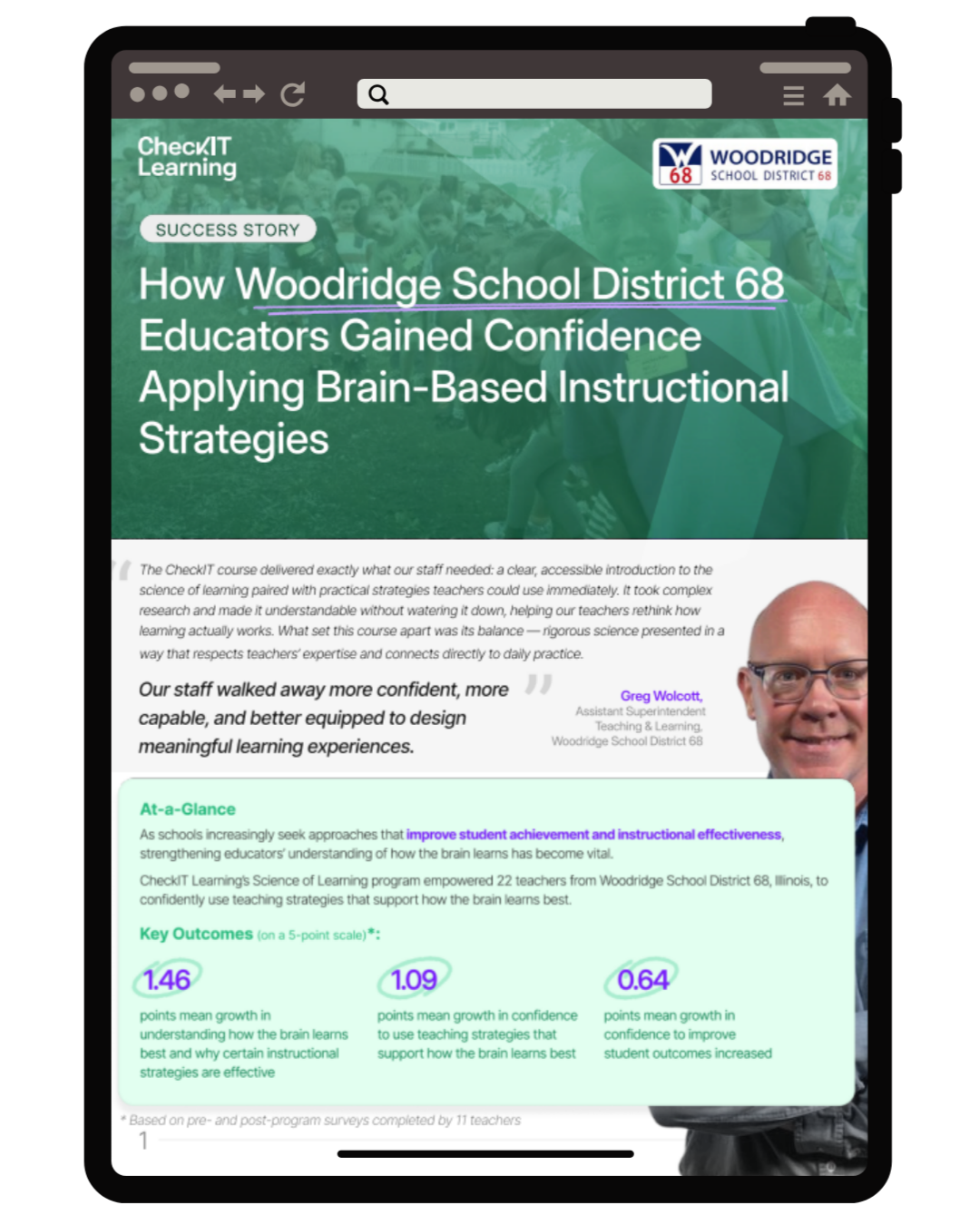
Analysis of pre- and post-pilot survey responses from the 11 (out of 22) participants who completed the program showed positive results across all targeted measurements.
The largest increase was observed in participants’ understanding of how the brain learns best and why certain instructional strategies are effective, with a mean growth of 1.46 points on a 5-point confidence scale. This represents a substantial increase in educator confidence, equivalent to moving nearly one and a half response levels on the survey scale.
Confidence in using teaching strategies that support how the brain learns best increased by 1.09 points, representing strong growth in participants’ confidence to apply learning science principles in practice.
Confidence in improving student outcomes increased by 0.64 points, indicating moderate growth in educators’ belief in their ability to positively impact student learning through evidence-based instructional practices.
These findings suggest that the professional learning experience strengthened both participants’ understanding of learning science and their confidence in applying that knowledge within educational settings. Collectively, these results indicate meaningful movement on a 5-point scale across all three measures, demonstrating that the pilot successfully increased educator confidence in the targeted areas of learning science and instructional practice.
“The Science of Learning micro-course was engaging, practical, and easy to understand.[] The course did a great job balancing research-based strategies with realistic classroom application, making it valuable for educators at any level.”
Lauren White, Instructional Coach, Woodridge School District 68, Meadowview School
Conclusions
In conclusion, the Professional Development and Micro-Course Pilot successfully achieved its primary objective of increasing educator confidence in applying learning science principles and evidence-based instructional practices. Participants demonstrated positive growth across all measured areas, including understanding how the brain learns best and why certain instructional strategies are effective, using teaching strategies that support how the brain learns best, and improving student outcomes.
This is a valuable evidence that a combination of live professional development and self-paced micro-course learning can effectively build educator understanding of cognitive science and its application to teaching and learning. Participant testimonials further reinforced the quantitative findings, highlighting the program’s practical relevance, accessibility, and immediate applicability to educational practice. Educators consistently reported that the learning experience helped translate complex research into actionable strategies that could be used to support instructional decision-making and student learning.
Full PDF available here.

A team of marketing and communication specialists exploring the incredible potential of neuroscience and AI in education.