How to Use AI to Craft Individualized Learning Plans: Meeting the Needs of Today’s Diverse Learners



By Dr. Staci Lorenzo Suits
When I began working as a school psychologist almost 30 years ago in the late 1990s, I was assigned to three elementary schools. I still remember very clearly that only one of my schools had classrooms specifically serving students with autism. In my other two schools, I cannot remember a single student who was identified as autistic.
Fast-forward nearly three decades, and the educational landscape looks remarkably different.
It is now uncommon to find a single classroom that does not include at least one student with autism, ADHD, and/or a specific learning disability. As neurodiversity becomes the norm rather than the exception in general education classrooms, teachers face the time intensive task of differentiating instruction for an incredibly diverse group of learners.
To meet this challenge without burning out, educators must look to modern tools. Artificial Intelligence (AI) offers a helpful, time saving tool to help teachers design, implement, and manage Individualized Learning Plans (ILPs) for students who need them. In this article, I use individualized learning plan broadly to describe a practical approach for intentionally matching instruction, supports, and ways of demonstrating learning to an individual student's profile—not a new special education document or compliance requirement.
The Changing Landscape of Classrooms
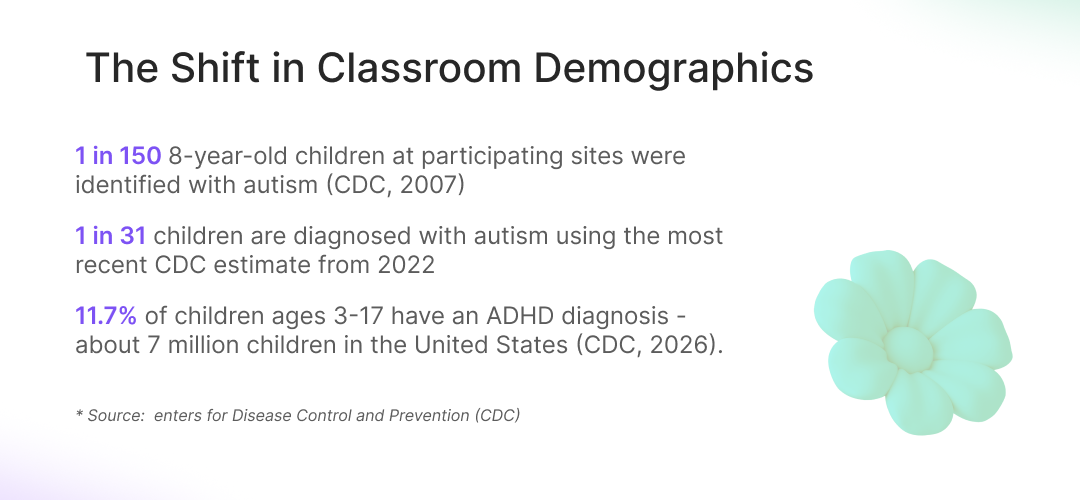
The shift in classroom demographics over the last three decades is backed by clear data and the numbers illustrate just how dramatically prevalence has changed. When the Centers for Disease Control and Prevention (CDC) began its Autism and Developmental Disabilities Monitoring Network in 2000, approximately 1 in 150 8-year-old children at participating sites were identified with autism (CDC, 2007). Using data from 2022, the most recent CDC estimate is approximately 1 in 31 children (CDC, 2025). For educators, that means autistic students are no longer the exception in general education classrooms; they are part of the everyday range of learners teachers are expected to support.
And autism is only one part of the picture. Rates of diagnosed attention-deficit/hyperactivity disorder (ADHD) have also increased substantially during my career. An analysis of nationally representative data found that the percentage of U.S. children and adolescents ages 4–17 diagnosed with ADHD increased from 6.1% in 1997–1998 to 10.2% in 2015–2016 (Xu et al., 2018). More recent CDC data indicate that approximately 11.7% of children ages 3-17 currently have an ADHD diagnosis, which is about 7 million children in the United States (CDC, 2026). Subsequently, teachers are supporting large numbers of pupils with attention, executive-functioning, self-regulation, and related learning needs.
Then consider learning disabilities. Specific learning disabilities, which include dyslexia (reading), dysgraphia (writing), and dyscalculia (math), represent the largest category of students receiving special education services under the Individuals with Disabilities Education Act (IDEA). Of the 7.5 million students ages 3–21 who receive special education services, approximately 32% are identified under the category of specific learning disability (NCES, 2024).
For educators, that means learning disabilities are not a specialized concern affecting only a small subset of students; they are a common part of the instructional needs present in today’s classrooms.
And those categories still capture only part of the variability educators encounter. Students may also experience language or motor differences, sensory-processing needs, mental health or medical conditions, attendance issues, giftedness, gaps in foundational skills, inconsistent school histories, or difficulties that have simply never been formally identified.
Taken together, these differences point to a fundamental shift in our school buildings:
Individualization is no longer primarily the responsibility of a specialized program down the hallway. It is part of everyday teaching.
More Individualization, Same Number of Hours
When I began my career, many students with more significant learning and developmental differences were educated primarily within specialized programs. Special education teachers received extensive preparation in adapting instruction, analyzing individual learning needs, modifying materials, monitoring individual progress, and designing interventions.
Today, far more of that work occurs within general education classrooms. That is an important evolution toward inclusion. But inclusion also changes what we ask teachers to do. And the challenge extends beyond students with formal diagnoses, IEPs, or 504 plans. Many students struggle in meaningful ways without any formal identification and still need individualized support.
As a result, a classroom teacher may be expected to simultaneously teach grade-level standards while supporting a student who struggles to decode text, another who reads three grade levels ahead, another who needs directions broken into individual steps, another who becomes overwhelmed by written output, another who struggles to initiate independent work, and another who understands the material but cannot demonstrate that understanding using the format provided. And tomorrow, the combination will be different.
Meeting that range of needs requires considerable instructional flexibility and expertise. Many general education teachers have received training in differentiation, Universal Design for Learning, accommodations, behavior support, or neurodiversity, but the majority do not have the specialized training of a credentialed special education teacher.
At the same time, teachers are being asked to do more—not less. Administrative demands, grading, lesson planning, classroom management, and countless other responsibilities already filling teachers' schedules. How can they realistically design individualized learning plans for multiple unique learners without spending every evening creating five versions of tomorrow's lesson?
This is where artificial intelligence becomes interesting.
Enter AI

Regardless of your feelings about artificial intelligence, generative AI is increasingly embedded in everyday usage and education. So we must ask ourselves, how can we leverage it responsibly to do things that good teaching already requires—but that teachers have never had enough time to do at this scale? A teacher can use AI to rapidly generate, adapt, compare, and refine instructional options that previously would have taken hours.
Of course, responsible use also requires attention to student privacy, data protection, and local or district policies on AI use. Educators should never enter personally identifiable information (PII) or protected health information (PHI) into public AI models.
With those safeguards in place, AI can become a practical tool for developing individualized learning plans that better reflect each student’s strengths, needs, interests, and learning profile.
Here are ten ways educators can use AI to support that process:
1. Start With the Learner, Not the Diagnosis
Before asking AI to solve a problem, describe the student’s strengths, interests, successful learning conditions, current skills, and areas of difficulty. A functional learning profile will produce more individualized suggestions than a diagnostic label alone.
For example:
I teach fourth grade. I have a student who is highly verbal, loves science and animals, contributes excellent ideas during discussion, and remembers information presented orally. She reads accurately but slowly and becomes fatigued during longer reading assignments. Written responses are brief because spelling and handwriting require significant effort. Suggest classroom supports that preserve grade-level thinking while reducing unnecessary reading and writing barriers.
2. Identify the Barrier Before Changing the Expectation
When a student struggles with an assignment, AI can help educators generate possible explanations for the difficulty before deciding how to intervene. The goal is not to assume why the student is struggling, but to consider what may be interfering with access or performance.
For example:
A student understands math concepts during discussion but completes very little independent work. Generate possible barriers I should investigate, including academic skills, attention, executive functioning, language, motor demands, task length, and presentation of the material. Do not assume a diagnosis or recommend lowering the learning expectation.
3. Create Multiple Pathways to the Same Learning Goal
AI can quickly generate different ways for students to access or practice the same content while preserving the instructional objective and cognitive demand.
For example:
The learning objective is for students to identify the main idea and supporting details in an informational text. Create five ways students could work toward this objective, including options that reduce reading, writing, language, attention, or organizational barriers. Keep the learning objective and level of thinking the same.
4. Adapt Existing Materials Without Rebuilding the Lesson
Teachers do not need to create separate lessons for every learner. AI can modify specific features of an existing activity while keeping the content and instructional goal intact.
For example:
Adapt this assignment without changing its content or learning objective. Shorten the directions, break them into numbered steps, reduce visual clutter, provide an example of the first item, and divide the activity into manageable sections.
5. Use Strengths and Interests to Increase Access and Engagement
Individualization should not focus only on what a student finds difficult. AI can help educators incorporate a learner’s interests, strengths, and preferred ways of engaging with information.
For example:
I have a student who struggles to initiate math tasks but is highly interested in space exploration and has strong visual reasoning skills. Create three ways to teach and practice fractions that incorporate those strengths and interests without changing the mathematical objective.
6. Design Executive-Functioning Supports
Sometimes the barrier is not the academic content but the cognitive load involved in starting, organizing, remembering, or completing the task. AI can help externalize those demands.
For example:
Break this essay assignment into a five-step checklist with clear, concrete actions. Include a starting cue, estimated stopping points, a self-check after each step, and a final review checklist. Use supportive, age-appropriate language.
7. Adjust Language and Reading Demands While Preserving Content
AI can make grade-level content more accessible when reading complexity or language demands interfere with a student’s ability to learn the underlying concepts.
For example:
Rewrite this paragraph about photosynthesis using shorter sentences and more accessible language. Preserve the essential science concepts and the terms “chlorophyll” and “carbon dioxide.” Do not simplify the scientific ideas themselves.
8. Create Alternative Ways to Demonstrate Learning
A traditional written response or test may measure reading, writing, or organizational demands in addition to the skill the teacher actually wants to assess. AI can generate other ways for students to demonstrate the same learning.
For example:
The goal of this assessment is to determine whether students understand the causes and effects of events in ancient Egypt. Generate four ways students could demonstrate that understanding, including written, verbal, visual, and multimedia options. Keep the expectations for content knowledge equivalent across options.
9. Generate Targeted Practice and Reteaching
AI can help teachers respond to specific patterns of error rather than assigning every student the same additional practice.
For example:
A student can correctly add fractions with the same denominator but repeatedly makes errors when the denominators differ. Generate three brief reteaching activities that target this specific misconception, followed by three practice problems I can use to determine whether the student now understands the concept.
10. Turn Supports Into a Plan That Can Be Evaluated
AI can help teachers organize individualized strategies into a simple plan that identifies what will be tried, when it will be used, what success will look like, and when the plan should be reviewed.
For example:
A student frequently understands assignments but has difficulty beginning independent work. Help me create a four-week classroom support plan. Include the barrier we are addressing, one or two strategies to try, when they will be used, a simple way to track whether they are helping, and questions the teacher and student can use at the end of four weeks to decide what to continue, change, or remove.
AI Generates Possibilities.
Teachers Make Decisions.
This may be the most important principle of all. AI can produce a list of strategies in seconds, but that does not mean all of them are good. AI can make mistakes: it may misunderstand a student's needs, recommend strategies without a strong evidence base, lower expectations when the better solution is improving access, reflect basis embedded in its training data or in the way a prompt is framed, or generate information that sounds authoritative but is simply incorrect.
That is why AI-generated recommendations should be treated as possibilities to consider, not decisions to follow. Consider whether the recommendation is developmentally appropriate, whether it is evidence-based, whether it preserves the learning objective, whether it builds independence rather than unnecessary dependence, and whether it fits what you know about this particular child. And then use your professional judgment.
In practice, this means that before using an AI-generated suggestion, ask: Does this preserve the learning goal? Is it appropriate for this learner? Is it evidence-informed? Does it reflect any assumptions or bias? Is it feasible in my classroom? And how will I know whether it helped?
UNESCO's AI Competency Framework for Teachers emphasizes precisely this human-centered approach: AI literacy for educators is not simply knowing how to operate an AI tool. It involves human agency, ethics, critical evaluation, pedagogical knowledge, and accountability (UNESCO, 2024).
From Individualized Programs to Individualized Classrooms
When I think back to those three elementary schools where I began my career, what strikes me most is not simply how much the statistics have changed. It is how much the responsibility for meeting diverse learning needs has changed.
Thirty years ago, many students with significant neurodevelopmental differences were educated primarily within programs specifically designed for them. Today, those learners are increasingly members of every classroom. The days of the one-size-fits-all classroom are gone.
I believe that is progress. But meaningful inclusion requires more than putting students in the same room. It requires access. It requires recognizing that equal instruction and equitable instruction are not always the same. And it requires giving educators realistic tools for individualizing learning without asking them to manufacture additional hours in the day.
AI may be one of the tools that helps make that possible. But AI cannot tell you who a child is or replace the relationship you have built with that student. It cannot observe the expression on their face when something finally clicks. It cannot know that they will write three sentences about a generic passage but three pages about roller coasters, marine animals, weather systems, or whatever topic makes their brain light up.
You know the learner. AI can help you act on what you know.
Used thoughtfully, ethically, and critically, artificial intelligence can save teachers time as they identify barriers, adapt instruction, and respond more efficiently to individual needs. Its greatest promise is not replacing what good teachers do, but making it more feasible to bring individualized, strengths-based instruction into everyday classroom practice within the time teachers actually have.
References
Centers for Disease Control and Prevention. (2007). Prevalence of autism spectrum disorders—Autism and Developmental Disabilities Monitoring Network, six sites, United States, 2000. MMWR Surveillance Summaries, 56(SS-1), 1–11. https://www.cdc.gov/mmwr/preview/mmwrhtml/ss5601a1.htm
Centers for Disease Control and Prevention. (2025, May 27). Data and statistics on autism spectrum disorder. National Center on Birth Defects and Developmental Disabilities. https://www.cdc.gov/autism/data-research/index.html
Centers for Disease Control and Prevention. (2026). Data on ADHD in children. National Center on Birth Defects and Developmental Disabilities. https://www.cdc.gov/adhd/data/index.html
National Center for Education Statistics. (2024). Students with disabilities. Condition of Education. U.S. Department of Education, Institute of Education Sciences. https://nces.ed.gov/programs/coe/indicator/cgg
UNESCO. (2024). AI competency framework for teachers. https://unesdoc.unesco.org/ark:/48223/pf0000391104 unesco.org
Xu, G., Strathearn, L., Liu, B., Yang, B., & Bao, W. (2018). Twenty-year trends in diagnosed attention-deficit/hyperactivity disorder among US children and adolescents, 1997–2016. JAMA Network Open, 1(4), e181471. doi:10.1001/jamanetworkopen.2018.1471.
This article was crafted by Dr. Staci Lorenzo Suits, an independent contributor engaged by CheckIT Labs, Inc. to provide insights on this topic.

Staci holds a doctorate in school psychology and diplomate status in school neuropsychology. She specializes in strength-based school neuropsychological evaluations and is especially passionate about strength-based neurodiversity-affirming practices, student self-advocacy, family engagement, and addressing educator burnout and retention.